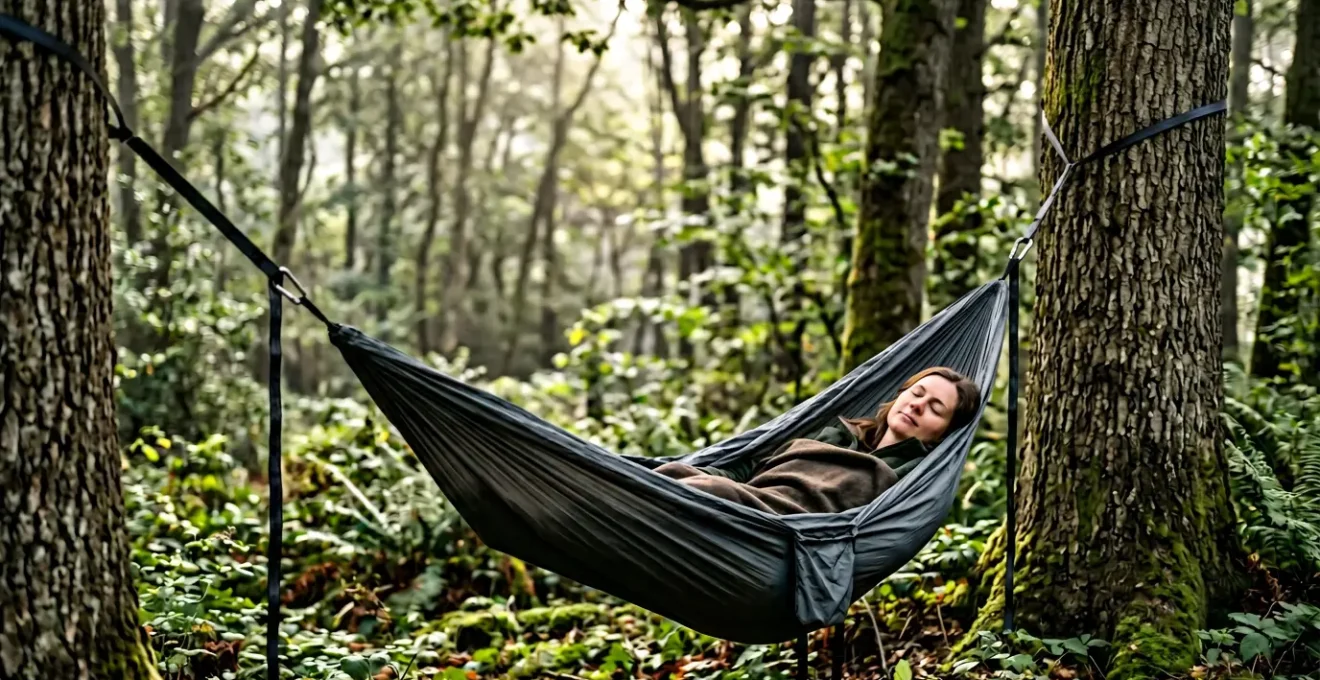
The dreaded « banana back » from hammock sleeping isn’t a flaw in the hammock, but a failure in setup. The solution isn’t to abandon your hammock, but to embrace sleep system engineering. By mastering the physics of a diagonal lay, controlling the structural sag with a ridgeline, and managing thermal ergonomics with proper insulation, you can transform a curved sling into a perfectly flat, zero-pressure sleeping plane that supports, rather than strains, your spine.
The promise of hammock camping is seductive: gently swaying to sleep under the stars, suspended away from the lumpy, damp ground. Yet, for many, this dream is shattered by a painful reality—waking up with a sore back, folded like a piece of fruit. This experience, known as « banana back, » is the number one reason campers abandon hammocks, convinced they are inherently bad for posture. Common advice like « use a pillow » or « just find a comfortable spot » barely scratches the surface of the problem.
But what if the issue isn’t the hammock itself, but how we use it? What if, instead of passively hoping for comfort, we could actively engineer a perfect, flat sleeping surface? The secret to a pain-free hammock night lies not in finding a magical product, but in understanding a few key ergonomic principles. It’s about transforming the hammock from a simple sling into a sophisticated, fine-tuned sleep system. This requires a shift in perspective: from fighting the curve to controlling the forces of tension, angle, and insulation.
This guide will deconstruct the science of hammock comfort. We will move beyond simplistic tips to provide a corrective, passion-driven framework for engineering your sleep system. We’ll explore the geometry of a flat lay, the crucial role of a structural ridgeline, the non-negotiable need for under-insulation, and the safety protocols that form the foundation of a restorative night’s sleep. Prepare to unlock the true ergonomic potential of your hammock.
To navigate this comprehensive guide to ergonomic hammock sleeping, here is a summary of the key engineering principles we will cover.
Summary: A Guide to Engineering a Pain-Free Hammock Sleep
- Why lying at 30 degrees flattens your sleeping surface instantly?
- How to keep your butt warm without a slipping pad?
- The ridgeline length error that ruins the sag angle
- Integrated net vs Sock: Which stops mosquitoes biting through fabric?
- When to reject a tree: The diameter and species safety check
- Why the ground sucks heat 3x faster than the air?
- Coniferous vs Deciduous forests: Which has fewer ticks?
- Shinrin-Yoku: How to Practice Forest Bathing for Proven Stress Reduction?
Why lying at 30 degrees flattens your sleeping surface instantly?
The single most important technique to eliminate the « banana back » is to lie diagonally, not in line with the hammock’s suspension. This simple shift in body position, roughly 10-15 degrees off the centerline, is the key to creating a flat sleeping surface. But why does this work? It’s a matter of pure physics. When you lie straight, your body follows the primary tension line, forcing your spine into a deep curve. Lying diagonally, however, transforms the fabric into a multi-axis tension grid.
This ergonomic magic happens because your weight is now distributed across the width of the fabric, not just its length. Your head is pushed towards one corner and your feet towards the opposite, creating lateral tension that pulls the fabric taut and flat beneath your torso. This creates the coveted « asymmetrical flat lay. » To achieve this, your hammock needs to be hung with the correct amount of sag, which is typically achieved when the suspension straps form a 30-degree angle with the tree. In fact, extensive testing confirms that the optimal hang angle for gathered-end hammocks is 30 degrees to facilitate this flat, diagonal position. This angle provides the ideal balance of sag and tension.
To better understand this, picture the fabric of the hammock. When you lie diagonally, you are effectively using your body as a cross-brace, activating the fabric’s structural potential. This concept is demonstrated in the image below.

As you can see, the stress is no longer concentrated along a single axis. The result is a surprisingly firm and supportive surface, often eliminating the need for a pillow entirely, though a small neck support or an inflatable pillow can further enhance comfort. Mastering this diagonal lay is the first and most critical step in engineering your sleep system for ergonomic success.
How to keep your butt warm without a slipping pad?
Even on a seemingly mild night, many new hammock campers are rudely awakened by a creeping, deep-seated chill in their back and hips. This phenomenon, aptly named « Cold Butt Syndrome » (CBS), occurs because your body weight compresses the loft of your sleeping bag, rendering its insulation useless. Air is a great insulator, but compressed material is not. The solution isn’t a slipping, bunching sleeping pad. The definitive answer is an underquilt.
An underquilt is essentially an insulated blanket that hangs on the *outside* of your hammock, creating a pocket of trapped, non-compressed air around you. This is the core principle of thermal ergonomics in a hammock. Because it’s suspended externally, its insulation remains fully lofted and effective. You start to lose significant heat through convection—the process of air stealing your warmth—at surprisingly high temperatures. Research and field experience show that most hammock campers begin experiencing convective heat loss below 70°F (21°C), making an underquilt essential for three-season camping.
Without an underquilt, your body will tense up to fight the cold, leading to muscle stiffness and exacerbating any postural issues. This makes proper insulation a critical component of ergonomic sleeping, not just a comfort item. An underquilt works in concert with your diagonal lay to ensure you remain warm, relaxed, and properly aligned all night. Installing one is straightforward and ensures you’re protected from the « bellows effect » where every movement pumps warm air out and sucks cold air in.
The ridgeline length error that ruins the sag angle
You’ve mastered the diagonal lay and the 30-degree hang angle. But how do you replicate that perfect setup every single time, regardless of the distance between trees? The answer is the structural ridgeline. This is a non-stretch cord that runs between the two ends of your hammock, setting a fixed distance and thus a consistent, perfect sag every time you hang it. It is the single most powerful tool for taking the guesswork out of your setup.
The most common error is either not using a ridgeline or using one that is the wrong length. A ridgeline that is too tight creates a flat, board-like hammock with intense shoulder squeeze and calf ridge pressure. One that is too loose results in an inescapable « banana back. » The magic number, derived from years of community testing and physics, is that the structural ridgeline should measure approximately 83% of the total hammock length. For a standard 11-foot hammock, this means a ridgeline of about 109 inches (or 9’1″). This precise length pre-configures your hammock to achieve the perfect 30-degree sag angle automatically.
With a structural ridgeline, you can hang your hammock suspension at steeper angles (up to 45 degrees) without affecting the comfortable sag of the hammock itself. The ridgeline becomes the load-bearing element that defines the shape, allowing you more flexibility in tree selection. It is the soul of your hammock’s geometry, transforming it from an unpredictable variable into a consistent, engineered sleep platform.
The impact of getting the ridgeline length wrong cannot be overstated. As a comparative analysis from Greenwashing Index’s technical guide shows, even small deviations from the optimal length can ruin comfort.
| Ridgeline Configuration | Sag Characteristics | Common Issues | Best Use Case |
|---|---|---|---|
| Too Tight (>85%) | Minimal sag, high tension | Calf ridge, shoulder squeeze, increased tree stress | Not recommended |
| Optimal (83%) | 30-degree angle, balanced sag | None – allows flat diagonal lay | Standard camping & sleep |
| Too Loose (<80%) | Excessive sag, deep curve | Inescapable banana back, knee hyperextension | Not recommended |
| Adjustable (80-85%) | User-customizable tension | Adds weight, requires experimentation | Shared gear, varying body types |
Integrated net vs Sock: Which stops mosquitoes biting through fabric?
A perfect ergonomic lay is worthless if you’re being eaten alive by mosquitoes. Effective bug protection is a non-negotiable part of your sleep system. The two primary solutions are an integrated bug net (sewn onto the hammock) or a separate « sock » or « cocoon » that slides over the entire hammock and ridgeline. Both have the same critical flaw: mosquitoes can and will bite you through the hammock fabric where your body presses against it, particularly at the shoulders and hips.
An integrated net is lightweight and can’t be forgotten, but offers a false sense of security. A sock-style net provides 360-degree protection and can help trap a small amount of warmth, but adds weight and setup complexity. Neither, on its own, solves the bite-through problem. The most effective strategy combines a physical barrier with a chemical one. This is where Permethrin treatment becomes a game-changer.
Permethrin is an insecticide that you apply to your hammock fabric *before* you head out. It’s odorless when dry and is highly effective at disabling insects on contact. By treating the bottom of your hammock, you create a « kill zone » that prevents mosquitoes from landing and biting through the fabric. According to Sawyer, a leading manufacturer, this permethrin fabric treatment provides protection for up to 6 weeks or 6 washings. This chemical shield is what truly makes either bug net system effective, allowing you to relax without the constant threat of bites on your back or elbows.
Ultimately, the choice between an integrated net and a sock comes down to personal preference for weight, convenience, and versatility. An integrated net is simpler, while a sock offers more complete coverage and a slight thermal benefit. However, the foundational truth is that without treating the hammock fabric itself, both systems remain vulnerable. True insect-proof comfort is achieved through this layered defense.
When to reject a tree: The diameter and species safety check
Your entire sleep system, no matter how ergonomically perfect, is only as safe as its anchor points. Choosing the right trees is the most important safety decision you will make. A catastrophic failure is not an option. The first rule is diameter: never hang from a tree that is less than 6 inches (15 cm) in diameter at chest height. A good rule of thumb is that if you can wrap your hands around it and your fingers touch, it’s too small. The tree must be alive, solid, and deeply rooted.
Beyond size, a thorough health inspection is mandatory. You must become vigilant about spotting « widowmakers »—dead branches, loose bark, or other debris in the canopy above you that could be dislodged by wind. Always look up and scan the entire area before committing to a spot. Reject any tree with signs of disease or structural weakness, such as large fungal growths (shelf mushrooms), deep cracks, lightning scars, or evidence of insect infestation. Some tree species are also inherently weaker; be wary of trees like Bradford Pears or certain pines known for dropping limbs.
Finally, protecting the tree is just as important as protecting yourself. Always use wide, tree-friendly suspension straps (at least 1 inch wide) to distribute the load and prevent damage to the cambium layer, the living tissue just beneath the bark. Thin ropes can girdle and kill a tree over time. A healthy forest is a safe forest. Before every hang, perform a systematic check of your surroundings.
Your Pre-Hang Tree Safety Checklist
- Check overhead: Scan the entire canopy above your planned hammock site for dead branches (widowmakers), loose bark, or hanging debris that could fall during wind or overnight.
- Inspect trunk integrity: Look for lightning-strike scars (vertical splits in bark), deep cracks, fungal growth (shelf mushrooms), or insect damage trails indicating structural weakness.
- Assess root stability: Avoid trees on eroding riverbanks, steep slopes, or with exposed root systems that compromise anchoring strength under load.
- Verify bark health: Reject trees with large areas of missing bark, thin fragile bark (like Beech or Birch), or species known for weak limb attachment.
- Use tree-protection straps: Always employ straps at least 1-2 inches wide to protect the cambium layer and distribute load, preventing damage that weakens the tree over time.
Why the ground sucks heat 3x faster than the air?
The title of this section might seem strange for an article about hammocks, which are defined by being off the ground. However, understanding why the ground is so cold is the key to understanding why you get cold in a hammock. The ground doesn’t « suck » heat; you lose it through a process called conduction—direct transfer of heat between two touching objects. Soil and rock are dense and conduct heat away from your body much more efficiently than air. This is why a simple sleeping bag isn’t enough for a tent camper; you need a sleeping pad to create a barrier.
In a hammock, you’ve solved the problem of conduction with the ground, but you’ve traded it for a much bigger problem: convection. You are suspended in open air, which constantly flows around you, stripping away your body heat from all sides. While air is a poor conductor, moving air is an incredibly effective heat thief. This is why an 80°F (27°C) day feels great, but an 80°F day with a 20 mph wind feels cool. Your hammock is always in that « windy » environment, even on a still night, because any air movement at all will affect you.
This brings us back to the crucial role of the underquilt. A sleeping bag, when used inside a hammock, fails for the same reason it fails on the ground without a pad: compression eliminates its insulating air pockets. As the Greenbelly Meals gear testing team explains, this is the core issue:
The issue is compression. When you are laying on your back in the hammock, you are compressing the insulation of the sleeping bag. Without air pockets to trap heat, this compressed part of the bag stays cold.
– Greenbelly Meals Gear Testing Team, Best Hammock Underquilts for Backpacking Guide
By creating an uncompressed layer of insulation *outside* the hammock, an underquilt directly combats convective heat loss. It’s the hammock camper’s equivalent of a tent camper’s sleeping pad, and it’s absolutely essential for maintaining the thermal balance required for a comfortable, ergonomic sleep.
Coniferous vs Deciduous forests: Which has fewer ticks?
Choosing your campsite involves more than just finding two perfectly spaced trees. The type of forest you’re in can have a significant impact on your exposure to pests, particularly ticks. Generally, ticks thrive in humid, dense environments with plenty of ground cover and leaf litter, which is more characteristic of deciduous forests (oak, maple, etc.). The thick layer of leaves provides the perfect moist habitat for them to quest for hosts. In contrast, coniferous forests (pine, fir, spruce) often have a floor covered in acidic pine needles, which creates a drier, less hospitable environment for ticks, potentially reducing their population density.
However, no forest is tick-free. The single greatest advantage of hammock camping is being suspended off the ground, away from the low-lying vegetation where ticks are most active. This inherent elevation provides a significant degree of natural protection during the night. As many experienced campers report, the primary risk of tick exposure comes during setup and teardown.
Experienced hammock campers consistently report that being suspended 18-24 inches off the ground provides natural protection against ticks, which primarily quest for hosts in low-lying vegetation and ground-level leaf litter. The primary tick exposure occurs during setup and teardown when interacting with the forest floor, not during the elevated sleep period.
– Dutchware Gear Expert Advice
This highlights the need for a multi-layered defense. While your hammock keeps you safe at night, you must protect yourself while on the ground. Treating your shoes and socks with Permethrin is one of the most effective measures you can take. A University of Rhode Island study found that people wearing permethrin-treated footwear were dramatically less likely to get a tick bite. This ground-level chemical barrier, combined with the hammock’s elevation and a treated hammock fabric, creates a comprehensive anti-tick system.
Key Takeaways
- The « banana back » is a setup failure, not a hammock flaw. A flat lay is achievable through engineering.
- A diagonal body position creates a « tension grid » that flattens the hammock surface. This is the ergonomic foundation.
- A structural ridgeline at 83% of the hammock’s length is critical for guaranteeing the perfect sag and a repeatable, comfortable hang.
Shinrin-Yoku: How to Practice Forest Bathing for Proven Stress Reduction?
We’ve spent this guide focused on the technical, ergonomic engineering of a perfect hammock sleep. But the ultimate goal of this meticulous setup is not just to avoid pain, but to achieve a state of deep, restorative rest. This is where the practice of Shinrin-Yoku, or « forest bathing, » intersects with the art of hammock camping. It’s about using the hammock as a tool to mindfully immerse yourself in the natural environment, which has been scientifically shown to reduce stress.
The process of fine-tuning your hammock—adjusting your diagonal lay, feeling the tension shift, and settling into that zero-pressure plane—can itself be a meditative act. It forces you to be present and aware of your body in space. Once you are comfortably suspended, the hammock becomes the perfect vessel for forest bathing. Gently swaying, you are disconnected from the hard ground and are free to observe the canopy, listen to the sounds of the forest, and feel the breeze. This elevated, slightly reclined posture may even be inherently beneficial.
Many doctors say it’s lying on one’s back, with the head slightly elevated, about 10 – 30 percent. This is postulated to give the brain optimal blood circulation rather than congestion and also allows for more un-obstructed breathing.
– Dr. Steven Park, Head and Neck Surgeon and Member of the American Academy of Sleep Medicine
You can transform the often-frustrating task of « getting comfortable » into a mindful practice. Instead of fighting with the hammock, partner with it. Use the setup process as a transition from the stress of your daily life to the calm of the forest. By engaging your senses and paying close attention to the micro-adjustments of your body and the hammock, you begin your Shinrin-Yoku practice long before you close your eyes to sleep.
By mastering these ergonomic principles, you transform your hammock from a potential source of pain into a precision tool for comfort, safety, and deep connection with nature. Your next step is to take this knowledge and apply it in the field, turning theory into a perfect night’s sleep.