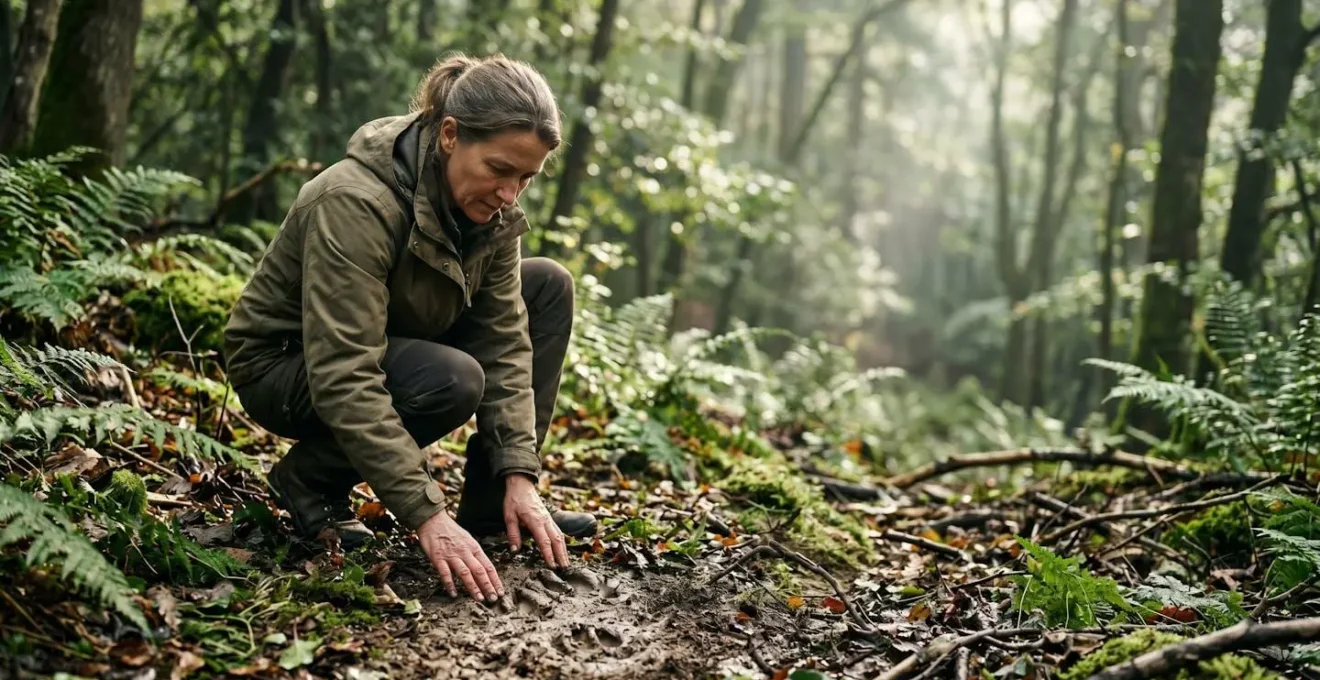
Seeing more wildlife isn’t about looking harder; it’s about becoming an invisible, silent observer that the forest accepts into its landscape.
- Most human presence, even quiet hiking, triggers physiological stress responses in animals from as far as half a mile away, causing them to hide or flee.
- The true key is sensory attunement—using all your senses to read the ecosystem’s subtle cues, from alarm calls to pressure shifts in a track, rather than just searching for animals.
Recommendation: Practice the « Sit Spot. » Find a comfortable place and remain perfectly still for 15-20 minutes. This is the time it takes for the forest to « forget » you are there, allowing wildlife to resume its natural behavior right before your eyes.
There’s a unique frustration known to many nature lovers: you step into a forest bursting with life, yet your entire hike is met with an unnerving silence. You hear the rustle of your own jacket, the crunch of your boots, but the deer, foxes, and elusive birds remain ghosts. You’ve followed the common advice—you walk quietly, you avoid bright colors, you go out at dawn—but the wildlife remains unseen, leaving you to wonder what you’re doing wrong. It feels like the forest is holding its breath, waiting for you to leave.
The conventional wisdom about wildlife spotting often stops at the surface. It tells you *what* to do, but not *how* to think. The truth is, most animals detect you long before you have any chance of seeing them. They don’t just see a hiker; they perceive a large, rhythmic, and predictable predator moving through their territory. Your steady pace and focused gaze are broadcast as a threat, sending ripples of alarm through the ecosystem. The fundamental mistake isn’t that you’re too loud; it’s that you’re moving and sensing the world like a human in a hurry.
But what if the solution wasn’t to search more actively, but to become more passive? What if the key to seeing wildlife was to master the art of self-effacement, to blend into the forest’s sensory landscape so completely that you are no longer perceived as an intruder? This is the core principle of the tracker’s mindset. It’s about shifting from an active hunter of sights to a quiet receiver of information, using every sense to read the stories the forest is constantly telling.
This guide will take you beyond the basic tips. We will explore the science of silent movement, the language of tracks left in the mud, and the critical mistakes that send animals running. You will learn how to engage your full sensory awareness, turning a simple walk into a profound connection with the living world around you, and finally start seeing the animals that have been there all along.
This article is designed to guide you through a complete mindset shift, from a casual hiker to a skilled observer. Below, you will find a detailed breakdown of the techniques and knowledge needed to transform your experience in the wild.
Summary: Unlocking the Secrets of the Unseen Forest
- Why walking silently increases wildlife sightings by 50%?
- How to identify animal tracks in mud after rain?
- The interaction mistake that provokes defensive behavior in animals
- Coniferous vs Deciduous forests: Which has fewer ticks?
- How to protect yourself from tick-borne diseases naturally?
- How to engage the 5 senses during a slow forest walk?
- How to modify your kit for snake bite zones specifically?
- Shinrin-Yoku: How to Practice Forest Bathing for Proven Stress Reduction?
Why walking silently increases wildlife sightings by 50%?
The common advice to « be quiet » in the forest is often misinterpreted as simply not talking. True silence, in a tracker’s sense, is about the rhythm and quality of your movement. Animals live in a rich soundscape, a baseline of normal noises—wind in the trees, a bird’s call, the scuttling of a squirrel. The steady, metronomic crunch-crunch-crunch of human footsteps is an unnatural and alarming intrusion into this soundscape. It’s a sound that signals a large, persistent creature, which in the wild often means a predator.
It’s not just about volume, but predictability. Animals are masters of pattern recognition. A deer might ignore the sudden snap of a twig, but it will be on high alert from the continuous, rhythmic sound of a hiker approaching from 200 yards away. The goal is to break this pattern. This involves an irregular pace: walk a few steps, pause, listen, and look around before taking a few more. This stop-and-start motion mimics the natural movement of browsing animals like deer, making your presence less threatening.
This approach is less about being perfectly silent and more about being less detectible. In fact, research confirms that animals are often more surprised by quiet humans. Cross-country skiers, for example, have a greater chance of startling wildlife than snowmobilers because their quiet approach doesn’t give the animal as much time to identify the source and retreat calmly. The research from Colorado State University reveals that it’s harder for animals to detect these quiet, dispersed activities, leading to closer and more surprising encounters. The ultimate technique is to become a part of the forest’s ambient noise, not a distinct signal within it.
How to identify animal tracks in mud after rain?
Rain transforms the forest floor into a canvas, and fresh mud is the perfect medium for capturing the stories of the creatures that passed through. Identifying tracks is more than just matching a shape to a picture in a field guide; it’s an exercise in forensic ecology. A clear print in the mud tells you not just *what* animal was there, but what it was doing, how heavy it was, and how recently it passed.
After a rain, the ground is soft, allowing for deep, clear impressions. Look for sharp, well-defined edges on the track. A track with crisp edges and perhaps a little water pooled in the bottom is extremely fresh, likely made within the last hour. If the edges are rounded and starting to dry or crumble, the track is older. The depth of the print reveals the animal’s weight and can even hint at its speed. Deeper impressions at the front of the track (the toe area) suggest the animal was accelerating or pushing off.
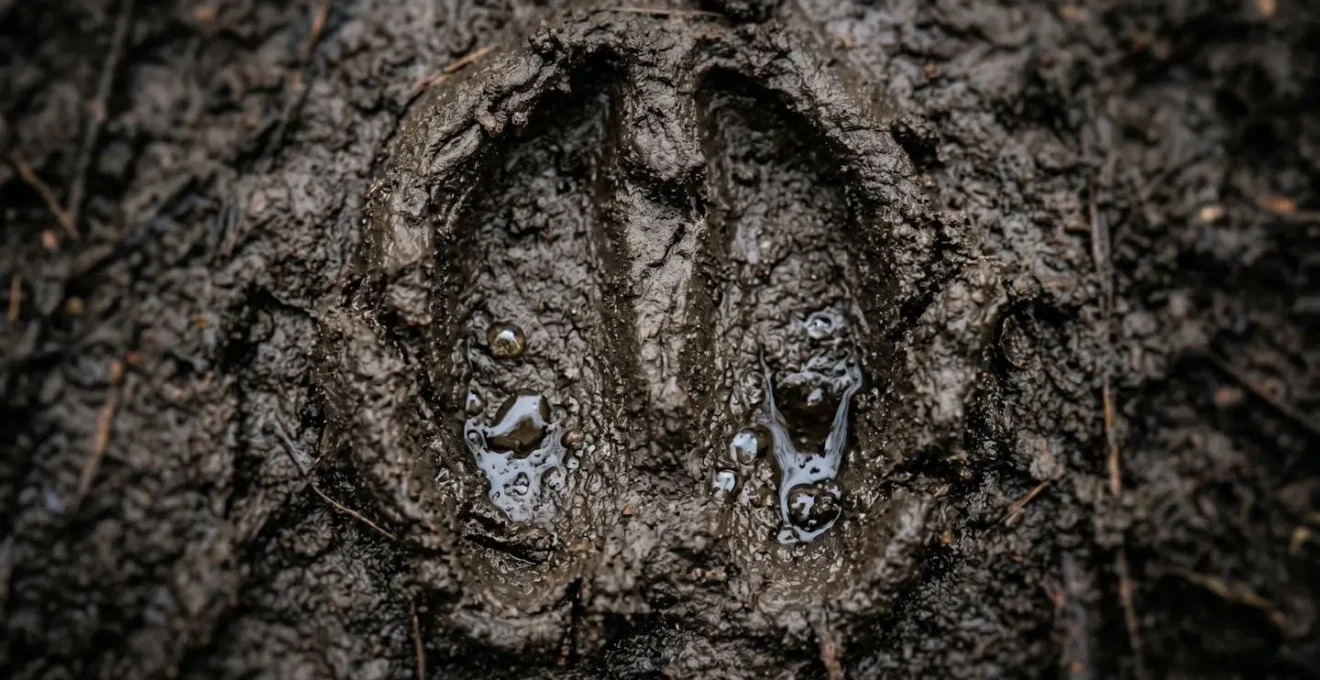
The details within and around the track are a language. The distance between prints (the stride) tells you if the animal was walking or running. A short, meandering stride might indicate a browsing deer, while long, leaping distances suggest flight. To truly become proficient, you must look at the collection of tracks as a whole, not just a single print. The following table breaks down the key characteristics to analyze.
| Track Characteristic | What It Reveals | Application in Interpretation |
|---|---|---|
| Depth | Animal weight and substrate condition | Compare tracks in same substrate and time; heavier animals leave deeper prints |
| Stride | Speed of movement (walking vs. running) | Measured heel-to-heel on same side; longer stride indicates faster movement |
| Straddle | Body width and gait pattern | Measured from outside edge of right track to outside edge of left track |
| Pressure Depth | Animal’s weight and speed | Deeper impressions at front indicate acceleration; even depth suggests steady pace |
This level of analysis, made possible by the perfect conditions of post-rain mud, turns a simple observation into a rich narrative about the unseen life of the forest. The data is available to anyone willing to learn how to read it, as shown in this comprehensive animal track identification guide.
The interaction mistake that provokes defensive behavior in animals
The single biggest mistake hikers make is underestimating their own impact. We often assume that if we aren’t actively chasing or threatening an animal, our presence is benign. The reality is that for most wild creatures, the mere detection of a human triggers a physiological stress response. This is the root of defensive behavior—not aggression, but a reaction to a perceived threat.
Defensive behaviors can range from freezing in place to a noisy, dramatic flight, or in rare cases, a bluff charge. These are not signs of a « mean » animal, but of a frightened one. The mistake is not a single action, but our entire mode of being in the forest: our size, our upright posture, our direct gaze, and our rhythmic, predictable movement all signal « potential predator » to an animal’s ancient instincts. We inadvertently provoke the very reaction that prevents a peaceful sighting.
The goal is to reduce this perceived threat. Avoid making direct, sustained eye contact, as this is a universal sign of aggression in the animal kingdom. Instead, use your peripheral vision. Move slowly and irregularly, as discussed before. If you do spot an animal, don’t walk directly towards it. Instead, continue on a path that angles away, signaling that you are not focused on it. Give it a wide berth and the clear option to retreat without feeling cornered.
Case Study: The Unseen Stress of a Quiet Hike
A comprehensive analysis from Colorado State University, reviewing 330 peer-reviewed articles, brought this issue into sharp focus. The research found that wild animals can experience physiological changes like increased heart rates and elevated stress hormones when they detect humans, even at distances up to half a mile. The study highlighted a paradox: quiet activities like hiking can actually be more disturbing in some ways because they lead to more surprise encounters, triggering a stronger « flight-or-fight » response compared to the predictable noise of a motorized vehicle, which animals can hear and avoid from farther away.
Coniferous vs Deciduous forests: Which has fewer ticks?
While a forest might seem like a uniform environment, its composition has a significant impact on the smaller, less welcome wildlife you might encounter—specifically, ticks. The type of trees that dominate a forest, whether coniferous or deciduous, creates a micro-environment that can either encourage or discourage tick populations. For the hiker looking to minimize risk, choosing a coniferous forest is generally the safer bet.
Deciduous forests, filled with broad-leafed trees like oak, maple, and beech, create a thick, rich layer of leaf litter on the forest floor. This litter traps moisture, creating the high-humidity environment that black-legged ticks (the primary carriers of Lyme disease) need to survive and avoid drying out. This damp, dark layer is also an ideal habitat for the small mammals that are crucial hosts for ticks in their larval and nymph stages, such as the white-footed mouse. More hosts and a perfect climate mean a higher density of ticks.
In contrast, coniferous forests—dominated by pines, spruces, and firs—have a different character. The ground is covered not in leaves, but in a mat of pine needles. This needle duff is more acidic and dries out much faster than leaf litter. It does not retain humidity well, creating a drier, less hospitable environment for ticks. While ticks are certainly not absent from coniferous forests, their populations tend to be significantly lower because the conditions for survival and reproduction are simply not as favorable. Therefore, if you have a choice, a hike through a pine-scented forest will generally carry a lower risk of tick encounters.
How to protect yourself from tick-borne diseases naturally?
While choosing the right forest can reduce your exposure, no environment is entirely free of ticks. The most effective strategy for preventing tick-borne diseases is not avoidance, but a diligent, systematic protocol of personal inspection after every single hike. Natural protection, in this context, means relying on physical checks and environmental awareness rather than chemical repellents alone. The key is to find and remove ticks before they have a chance to transmit any pathogens, which typically takes 24 hours or more.
Your first line of defense is awareness on the trail. Ticks « quest » by climbing onto blades of grass or shrubs and waiting for a host to brush past. Staying in the center of well-maintained trails can dramatically reduce your chances of an encounter. A 2021 study in Belgium found that tick density was lowest on and immediately next to trails and benches, with the highest concentrations found deeper in the forest interior. Avoid walking through tall grass and thick underbrush whenever possible.
Once you return home, the real work begins. Don’t wait until bedtime; a thorough check as soon as possible is critical. Ticks are drawn to warm, moist areas of the body. The following protocol outlines a systematic way to ensure no tick goes unnoticed, providing the most reliable form of natural protection.
Your Post-Hike Tick Check Action Plan
- Immediate Body Scan: Conduct a full-body tick check within two hours of returning, focusing on warm, moist areas: under the arms, in and around the ears, inside the belly button, behind the knees, between the legs, around the waist, and in the hair and scalp.
- Systematic Clothing Inspection: Remove hiking clothes before entering your main living areas. Tumble dry them on high heat for at least 10 minutes to kill any ticks that may have latched onto the fabric, even before washing.
- Gear Quarantine & Check: Inspect your backpack, shoes, and any other gear, paying close attention to seams and folds where ticks can hide before bringing them indoors.
- The Shower Method: Showering within two hours of coming indoors has been shown to be effective for washing off unattached ticks and provides another opportunity to conduct a thorough body check.
- Pet Patrol: If you hike with a dog, check them meticulously after every outing. Focus on their ears, between their toes, under their collar, and around their eyelids and tail.
How to engage the 5 senses during a slow forest walk?
To truly see the forest, you must stop looking so hard with just your eyes. Shifting into an observational mindset means activating your entire sensory apparatus. It’s about moving from a narrow, forward-focused « hiker’s gaze » to a wide, receptive awareness that takes in information from all directions and through every sense. This is how animals perceive their world, and by emulating it, we become less of an anomaly and more a part of the environment.
Sight: Soften your gaze. Instead of focusing intensely on the path ahead, relax your eyes and become aware of your peripheral vision. This « owl eye » technique allows you to detect subtle movements at the edges of your vision, which is often where an animal will first appear. Scan the landscape in layers—foreground, mid-ground, background—looking for shapes that are out of place, a horizontal line in a world of vertical trees (the back of a deer), or the flick of an ear.
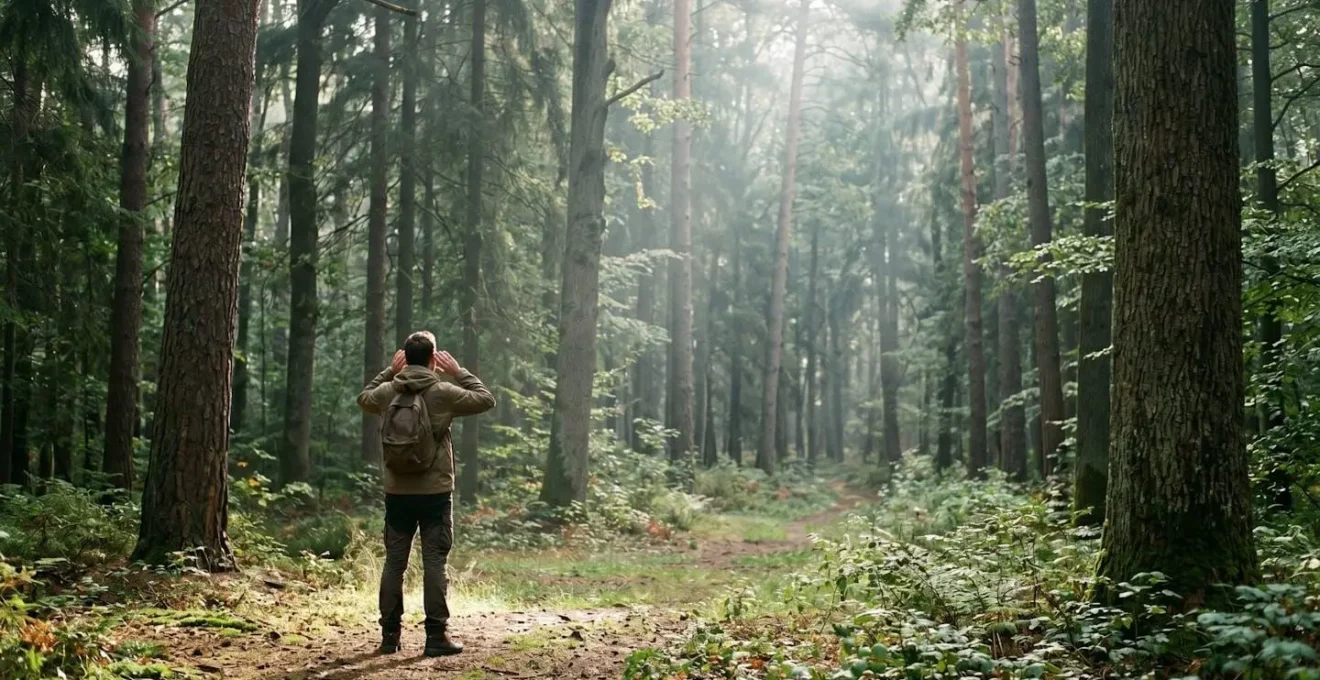
Hearing: This is perhaps your most powerful tool. Stop walking, close your eyes, and just listen for a full minute. Cup your hands behind your ears to amplify distant sounds. First, identify the baseline soundscape. Then, listen for disturbances: the sharp alarm call of a jay, the sudden silence of chirping insects, or the rustle in the undergrowth that moves against the direction of the wind. These are the sounds of the forest reacting to something—and that something could be another animal, or you.
Touch, Smell, and Taste: Feel the temperature change as you enter a shaded grove. Notice the feeling of the ground under your feet—is it soft and damp or dry and brittle? Inhale deeply. Can you smell damp earth, crushed pine needles, or the musky scent of a nearby animal? While tasting things in the wild is generally not advised, you can engage this sense by noticing the taste of the clean, humid air. As researchers noted in a study on mindful walking, the direct experience of nature is profoundly impactful. As Reinier de Nooij and his colleagues observed in their study, « Silent into Nature »:
Several factors were identified as conducive to positive effect, such as encountering nature, negotiating obstacles, duration of the walk, and walking in silence.
– Reinier de Nooij et al., Silent into Nature
How to modify your kit for snake bite zones specifically?
While the overarching theme of wildlife observation is silence and stealth, there is one major exception: snakes. Unlike a deer you wish to observe, a snake is an animal you do not want to surprise. Most snakebites occur when a snake is startled or feels trapped. Therefore, in areas known for venomous snakes, your strategy must shift from silent observation to purposeful announcement. It’s about making your presence known to give them ample opportunity to move away.
Your standard hiking kit can be easily adapted for this purpose. The goal is to create ground vibrations and noise, as snakes « hear » through vibrations in the ground more than through the air. Here are the key modifications and techniques:
- Use Hiking Poles Actively: Your trekking poles are your best tool. Don’t just use them for balance; tap them firmly on the ground and in front of you, especially before stepping over logs or into thick brush where you can’t see your feet. The vibrations will alert any nearby snake.
- Wear Sturdy Boots and Gaiters: High-topped, thick leather or synthetic boots provide a crucial physical barrier. In areas with a high concentration of venomous snakes like rattlesnakes, snake-proof gaiters that cover the area from your ankle to your knee are a wise investment.
- Make Deliberate Noise: This is where you break the rule of silence. When walking through tall grass or areas with poor visibility, talk, whistle, or occasionally stomp your feet. This isn’t about being obnoxious; it’s a safety measure to announce your approach.
- Carry a Headlamp, Even During the Day: Snakes often retreat into dark, cool places like crevices in rocks or hollow logs. A headlamp allows you to peer into these areas before reaching into them.
This proactive awareness is your most important piece of gear. Learn to recognize prime snake habitats—sunny, open patches for basking next to the cover of rocks or logs. Be especially cautious when gathering firewood or sitting down for a rest. Never put your hands or feet where you can’t see.
Key takeaways
- The art of seeing wildlife lies in mastering silent, irregular movement to blend into the forest’s natural rhythm and avoid triggering predator-detection patterns.
- The most powerful and underutilized tool for wildlife observation is the « Sit Spot »—staying perfectly still for 15-20 minutes allows the ecosystem to accept your presence and resume normal activity.
- Shifting from a narrow, visual search to a full sensory awareness—listening for alarm calls, watching for subtle movements in the periphery, and feeling the environment—is more effective than simply looking for animals.
Shinrin-Yoku: How to Practice Forest Bathing for Proven Stress Reduction?
The practice of Shinrin-Yoku, or « forest bathing, » is the culmination of everything we’ve discussed. It is the art of consciously immersing yourself in the forest atmosphere, and it is perhaps the most profound method for both stress reduction and wildlife observation. It formalizes the shift from a goal-oriented hike to a state of being present and receptive. The goal is not to cover distance, but to connect with the environment through all your senses.
At its heart, Shinrin-Yoku is a slow, meditative walk. You leave your phone and camera behind. You find a trail and walk without a destination, letting your body and curiosity guide you. You practice the sensory engagement we explored earlier: you notice the light filtering through the canopy, you listen to the bird song, you feel the texture of bark, you smell the scent of the soil. It is a practice of active stillness, where you are both relaxed and highly aware.
The most powerful component of Shinrin-Yoku for wildlife observation is the « Sit Spot. » This involves finding a comfortable place to sit for an extended period, typically 20-30 minutes, and simply observing without expectation. This is where the magic happens. After you’ve been still for about 15 minutes, a remarkable transformation occurs: the forest begins to forget you are there.
Case Study: The 15-Minute Rule of Invisibility
A qualitative study of a mindful walking retreat in the Netherlands provided powerful evidence for this phenomenon. Participants walked in silence along a river, and a key practice was the « Sit Spot. » The research found that this period of stillness was exceptionally effective for positive experiences. It was observed that after about 15 minutes of stillness, local wildlife resumes natural behavior, having seemingly accepted the human presence as a non-threatening part of the landscape. This is the threshold where squirrels resume their foraging, birds return to their singing, and a deer might step cautiously out of the thicket, allowing for incredible, authentic sightings.
Practicing Shinrin-Yoku teaches you patience and dissolves the barrier between observer and observed. You are no longer an intruder trying to steal a glimpse of nature; you are a quiet part of the scenery, privileged to witness its daily life unfold.
The forest is waiting. Your next hike is not just a walk, but an invitation to listen, to see, and to become part of the story. Step out not as a visitor, but as a quiet observer, and discover the vibrant, hidden world that was always there, waiting for you to become still enough to see it.