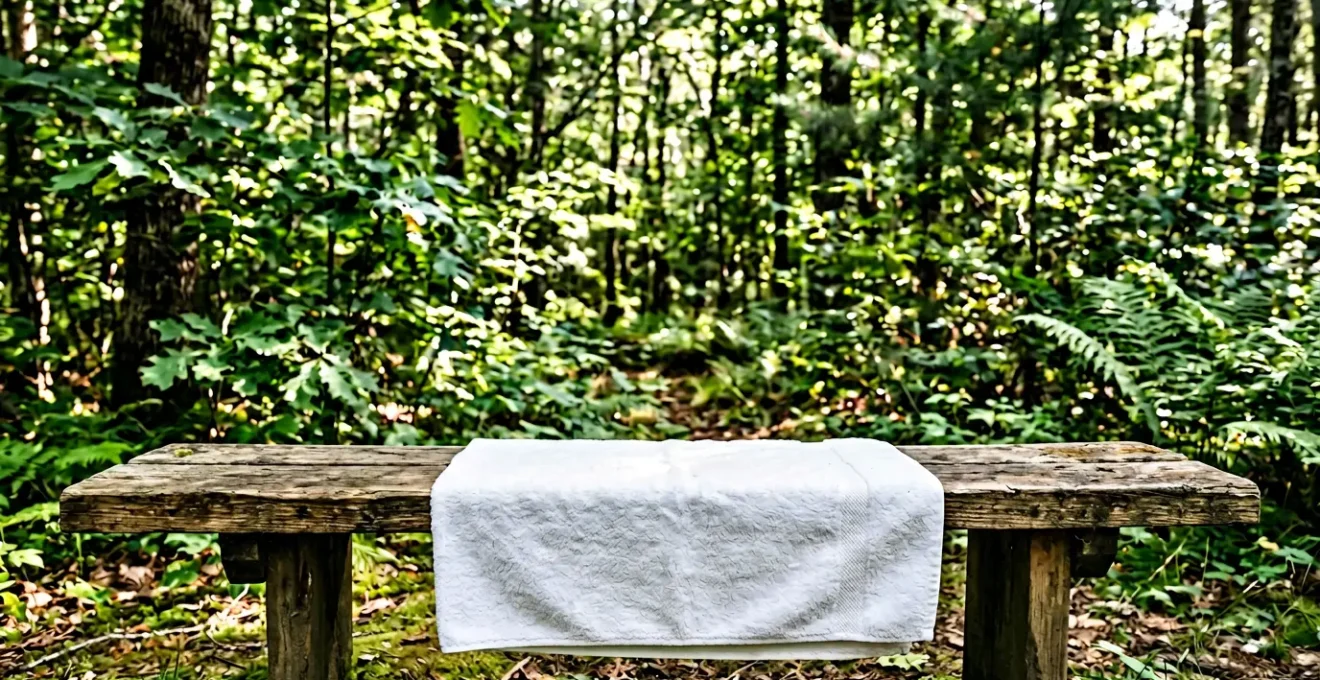
Contrary to the belief that the towel rule is simply about ‘good manners,’ it is a critical public health protocol. This guide dismantles that myth, revealing the microbiological evidence that proves your towel is an essential barrier against pathogen transmission. Ignoring it is not just impolite; it’s a sanitary risk to yourself and the entire community.
For the newcomer to naturism, the « always sit on a towel » directive can feel like an awkward, even burdensome, piece of etiquette. You’ll often hear it explained in terms of ‘respect’ or ‘keeping seats clean’—vague notions of courtesy that don’t fully resonate with someone seeking freedom from convention. This perspective, however, dangerously trivializes a fundamental public health mandate. The towel rule is not an arbitrary social custom; it is a non-negotiable protocol grounded in microbiology, designed to prevent the transfer of bacteria, fungi, and viruses.
This is not about etiquette. This is about science. The shared surfaces in a naturist environment—from wooden sauna benches to plastic lounge chairs—are potential vectors for pathogen transmission. Your body, in turn, can both deposit and acquire microorganisms. The towel is not a comfort accessory; it is your personal, portable sterile field, your primary line of defense in an invisible war against contamination. Understanding its function is the first step toward becoming a responsible and health-conscious member of the naturist community.
This article will systematically deconstruct the scientific imperative behind this rule. We will explore the microbial world thriving within towel fibers, establish practical protocols for carrying and maintaining your towel as a hygienic barrier, and extend this principle of sanitation to the wider environment. Prepare to see your towel not as a burden, but as the most essential piece of equipment you own.
To navigate this essential topic, this guide is structured to provide a comprehensive understanding of every aspect of naturist hygiene. Below is a summary of the critical areas we will cover, from personal practice to communal responsibility.
Summary: The Scientific Imperative of Naturist Hygiene
- Why a standard bath towel is too small for full protection?
- How to carry your towel hands-free during activities?
- The « Side A / Side B » marking trick to avoid sitting on the dirty side
- When to wash: Does a daily rinse kill bacteria effectively?
- How politely remind someone to use their towel on public benches?
- The sanitation mistake that ruins local ecosystems in 24 hours
- The « textile error »: Why dressing up for dinner can be offensive?
- Crossing the Line: How to Identify Boundaries of Clothing-Optional Zones?
Why a Standard Bath Towel Is Too Small for Full Protection?
The assumption that any towel will suffice is a critical failure in hygienic protocol. A standard-sized bath towel is fundamentally inadequate because it fails to provide a sufficient sterile field. The objective is not merely to avoid direct contact at the center of your body but to create an impermeable barrier that accounts for inevitable shifting, repositioning, and movement. A small towel’s edges can easily curl or slide, allowing your skin to make contact with the communal surface, rendering the entire practice pointless. This single point of contact is all that is needed for pathogen transmission.
The risk is magnified by the microscopic nature of contamination. It’s not about visible dirt; it’s about the invisible microbial load. A groundbreaking 2023 study in Scientific Reports on towel biofilms revealed that bacteria don’t just reside on the surface. They form dense colonies, or biofilms, deep within the towel’s fiber structure, particularly at the root of the pile. This means even a seemingly clean towel can harbor a significant microbial population. If that towel is too small, any part of the communal chair or bench you touch can then contaminate you, or vice-versa.
Therefore, selecting a large beach towel or an oversized bath sheet is not a matter of luxury; it is a mandatory requirement for effective hygiene. The towel must be large enough to extend well beyond your body’s footprint in any seated or reclining position. This ensures a consistent and reliable hygienic barrier between your skin and any shared surface, neutralizing the threat of cross-contamination. Anything less is a compromise on health and safety.
How to Carry Your Towel Hands-Free During Activities?
Maintaining constant hygienic readiness is paramount. Your towel is a piece of personal protective equipment that must be immediately deployable before any part of your body makes contact with a communal surface. Leaving it on a chair while you walk to the pool or participate in an activity defeats its purpose entirely. The challenge, therefore, is to integrate the towel into your movements so that it is always with you, without being a cumbersome burden. This requires adopting a procedural mindset, not one of casual convenience.
For any naturist, mastering hands-free carrying techniques is a core skill. It ensures compliance with hygiene standards while allowing for freedom of movement during activities like walking, hiking, or participating in resort games. The method chosen may vary based on the activity’s nature, but the principle of constant accessibility remains unchanged. This is not about fashion; it is about function and preparedness.
To ensure your towel is always on your person and ready for use, adopt these strict operational procedures:
- Universal Rule: Your towel must accompany you everywhere you go within a naturist venue. There are no exceptions.
- Short-Range Movements: For brief walks to facilities or between locations, a simple wrap is sufficient. Wear it sarong-style around the waist or drape it over the shoulders for immediate access.
- Active Pursuits: During hiking or sports, a hands-free system is mandatory. The most effective method is using a carabiner clip to attach a lightweight, quick-dry microfiber towel to a belt loop (if wearing shorts in a transition zone) or a simple cord worn around the waist.
- Seated Preparedness: When approaching any seating area, your towel should be unfolded and ready. Practice the « towel-first » habit: the towel is placed *before* your body makes contact.
Treating your towel as an extension of your body, rather than a separate accessory, transforms this rule from a chore into an ingrained, automatic safety behavior. It is the hallmark of a responsible and hygienically aware naturist.
The « Side A / Side B » Marking Trick to Avoid Sitting on the Dirty Side
The function of the towel as a hygienic barrier is twofold: it protects the surface from you, and it protects you from the surface. However, this entire system collapses if you fail to manage cross-contamination on the towel itself. Placing the « surface side » of your towel—the side that has been in contact with a public bench—directly onto your skin is hygienically equivalent to not using a towel at all. You are simply transferring the potential contamination vector from the bench to your own body. This is a common and dangerous mistake.
To prevent this, a strict « Side A / Side B » protocol is not just a clever trick; it is a mandatory procedure. You must have an unambiguous system for distinguishing the clean side (Side A, for your body) from the potentially contaminated side (Side B, for the surface). This requires conscious effort and a consistent method. Folding your towel with the contaminated Side B always on the inside is a basic first step, but a more robust physical marker is recommended for absolute certainty, especially with single-color towels where a fold can be easily confused.
Consider this a non-negotiable part of your personal hygiene kit. A small, color-coded safety pin attached to one corner of « Side A » or a sewn-in loop of colored thread provides a clear tactile and visual cue. This eliminates guesswork and ensures you never inadvertently expose your skin to the collected microbial load from every surface you’ve sat on. The texture of the towel, as seen in the image below, is a perfect environment for trapping microbes, making this separation critical.
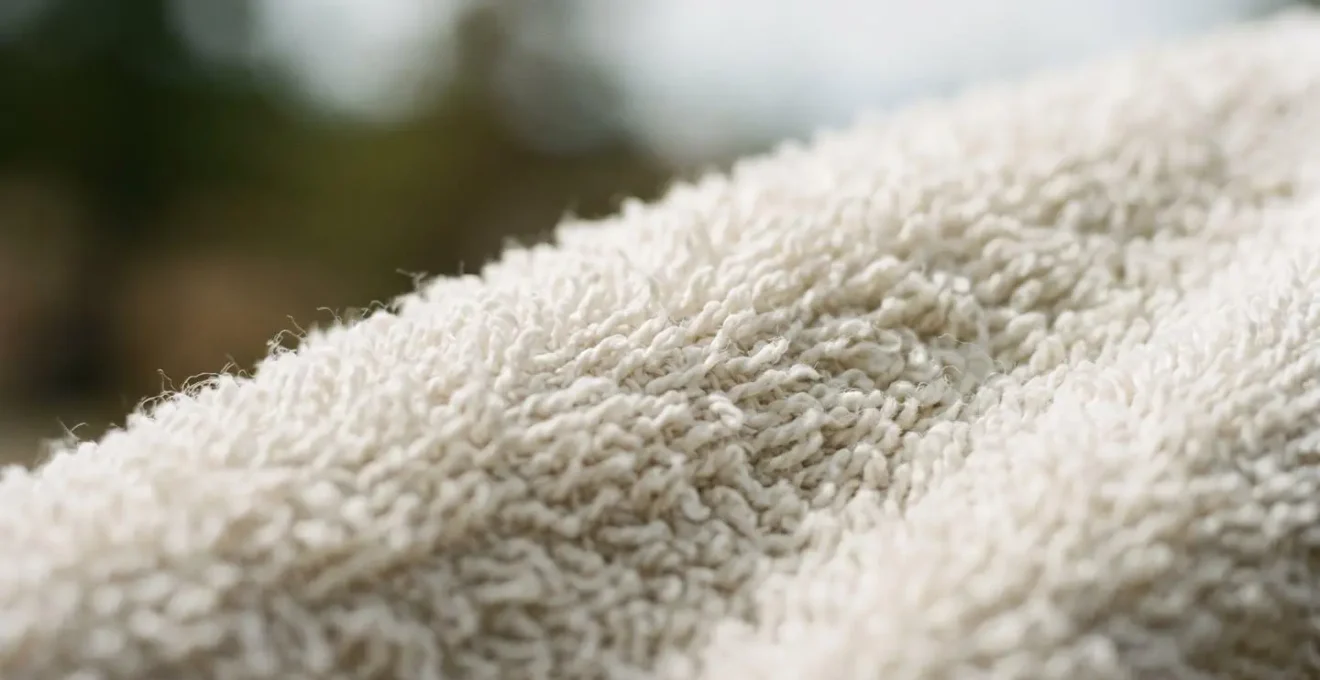
The intricate weave shown here demonstrates how easily microscopic particles and microorganisms can become trapped within the fibers. Without a clear system, you are simply carrying that contamination with you and reapplying it to your skin later. Implementing a marking system is a simple, zero-cost action that dramatically increases your hygienic security.
Your Personal Towel Hygiene Protocol Audit
- Surface Contact Points: List all communal surfaces you typically use (benches, pool loungers, sauna wood, dining chairs). Acknowledge every potential point of contact.
- Towel Inventory & Sizing: Audit your primary towel. Is it large enough to prevent ALL accidental skin contact with a surface, even if you shift or recline? If not, it is inadequate.
- Cross-Contamination Check: Do you have an infallible system (e.g., a specific fold, a physical marker) to distinguish the ‘body-side’ from the ‘surface-side’? Test its reliability.
- Emotional vs. Factual Compliance: Reflect on your behavior. Are you using the towel out of rote habit, or are you actively thinking of it as a sterile barrier and managing it accordingly?
- Integration Plan: Identify the single weakest point in your current protocol. Define an immediate, concrete corrective action (e.g., « I will purchase a larger towel by next week, » or « I will sew a red thread onto the ‘body-side’ corner tonight »).
When to Wash: Does a Daily Rinse Kill Bacteria Effectively?
A common and hazardous misconception is that a simple water rinse is sufficient to « clean » a towel after a day’s use. This is unequivocally false. From a microbiological standpoint, rinsing with water alone does almost nothing to remove the most significant sanitary threat: the biofilm. Bacteria, skin oils, and sweat create a greasy, protective matrix that adheres tightly to the towel’s fibers. Water simply flows over this layer, leaving the underlying bacterial colonies undisturbed and well-fed. This practice provides a false sense of security while cultivating a perfect breeding ground for pathogens.
The scientific consensus is clear and unforgiving. As researchers behind a key study on towel hygiene stated, a rinse is not a wash.
A simple water rinse is not enough to remove the oily biofilm layer which traps and feeds bacteria – this requires soap (surfactants) to break it down.
– Scientific Reports research team, Analysis of biofilm and bacterial communities in the towel environment with daily use
To properly decontaminate a towel, you must use a surfactant—the active ingredient in soap. Surfactants work by breaking the surface tension of water and emulsifying oils and grease, allowing the biofilm to be lifted from the fibers and washed away. Therefore, a daily wash with soap and a thorough rinse is the minimum standard for towel hygiene. For multi-day trips without access to laundry, you must bring multiple towels.
In situations where a full wash is impossible, the only viable supplementary disinfection method is ultraviolet (UV) radiation from the sun. While not a replacement for washing, a study on textile sanitation shows that exposing a towel to at least 30-60 minutes of direct sunlight can kill a significant portion of surface bacteria. The towel must be fully unfolded and exposed on both sides. However, this should be considered an interim measure, not a substitute for a proper wash with soap.
How Politely Remind Someone to Use Their Towel on Public Benches?
Encountering someone who is non-compliant with the towel rule is not a matter of social awkwardness; it is a public health event that requires intervention. Your silence makes you complicit in the potential spread of pathogens. The goal is not to shame or embarrass, but to correct a breach in communal safety protocol swiftly and effectively. Framing the interaction from a place of shared responsibility, rather than personal accusation, is the most effective strategy. This is a moment for community stewardship, not social anxiety.
The most successful approach is a discreet, non-confrontational, and assumption-of-good-intent reminder. The person may be new, forgetful, or simply unaware of the rule’s gravity. A hostile or judgmental tone will only create defensiveness and undermine the spirit of the community. The objective is compliance. A calm, direct, and friendly delivery is the most professional and effective way to achieve this. The environment of a naturist resort is one of mutual respect, and that respect is demonstrated by upholding shared health standards.

When you must intervene, choose your words carefully to be helpful rather than critical. Instead of a direct command like « You need to use a towel, » which can sound accusatory, try a gentler, more collaborative phrase. Simple statements like, « I think you might have forgotten your towel, » or a quiet, « Just a friendly reminder about using a towel on the benches, » are highly effective. You can also lead by example, pointedly placing your own towel down before you sit near them. This non-verbal cue is often enough to prompt action without a single word being spoken. Remember, you are not the « towel police »; you are a responsible member of a community upholding a vital health standard. The rule is absolute: when naked, you only sit on what belongs to you.
The Sanitation Mistake That Ruins Local Ecosystems in 24 Hours
The hygienist’s responsibility does not end with personal and communal surfaces. A rigorous commitment to cleanliness must extend to the surrounding environment. The single most destructive sanitation mistake made in naturist or camping settings is washing with soap or detergent—even biodegradable types—directly in or near natural water sources like lakes, rivers, or streams. This seemingly harmless act introduces pollutants that can devastate a local aquatic ecosystem with alarming speed.
The primary culprits are phosphates, common in many detergents. As environmental research demonstrates, phosphates cause eutrophication, an explosive growth of algae. This « algal bloom » blocks sunlight from reaching aquatic plants, killing them off. As the algae and plants die and decompose, the process consumes dissolved oxygen in the water, creating hypoxic « dead zones » where fish and other aquatic life cannot survive. This entire destructive cascade can be triggered by a single washing session.
Therefore, the 200-foot rule is a non-negotiable environmental health protocol. All washing activities—of bodies, dishes, or towels—must take place at least 200 feet (approximately 60 meters) away from any water source. This allows the soil to act as a natural filter for the greywater, breaking down pollutants before they can reach and poison the ecosystem.
- Establish a Boundary: Mentally or physically mark a line 200 feet away from any shoreline. All washing occurs beyond this line.
- Use a Basin: Always carry water away from the source in a bucket or collapsible basin for washing. Never rinse directly in the lake or stream.
- Use Minimalist Soap: Use only small amounts of biodegradable, phosphate-free soap. Even « eco-friendly » products are pollutants in a direct water source.
- Disperse Greywater: Scatter the used wash water (greywater) widely over the ground, far from the water source. Do not pour it in one spot, which overwhelms the soil’s filtering capacity.
True naturism involves a respect for nature that goes beyond simple appreciation. It demands active stewardship and a commitment to leaving no trace. Violating this protocol is a profound breach of that ethos and a direct act of environmental degradation.
The « Textile Error »: Why Dressing Up for Dinner Can Be Offensive?
While it may seem counterintuitive, in many naturist settings, the act of getting « dressed up » for a communal event like dinner can be perceived as a social and ideological transgression. This « textile error » is not about the presence of clothing itself, but about the *type* of clothing and the message it sends. A simple sarong worn for warmth or a towel wrapped for transitioning is functional. A coordinated outfit, however, can signal a departure from the community’s core ethos of egalitarianism and acceptance.
This perception is rooted in the philosophy that naturism is about removing the social hierarchies and judgments associated with clothing. As one leading organization explains, clothing can create an uncomfortable power dynamic.
Wearing clothes when others are nude can make one appear as an ‘observer’ rather than a ‘participant,’ which undermines the communal, egalitarian spirit of naturism.
– AANR West (American Association for Nude Recreation), Naturist Etiquette: How to Behave in a Clothing-Optional Environment
This does not mean clothing is always forbidden. Hygiene and practicality often dictate a dress code. A comprehensive analysis of naturist resort policies shows a nuanced approach. For example, clothing is almost always mandatory in indoor dining rooms for clear sanitary reasons—to prevent direct body contact with chairs and tables where food is served. Likewise, pools and hot tubs are typically « nude-only » zones to prevent fibers and dyes from contaminating the water filtration systems. The key is understanding the context: clothing for function and hygiene is accepted; clothing for social status or to create distance is often not.
The error lies in failing to read the environment and its specific rules. Before attending any event, a responsible naturist clarifies the dress code. When in doubt, the default should be to align with the majority and the spirit of the venue, which prioritizes a « human-to-human » connection over a « costume-to-costume » one.
Key Takeaways
- The towel rule is a scientific public health mandate, not optional etiquette, designed to prevent pathogen transmission.
- Effective hygiene requires a large towel, a strict « Side A/Side B » system for preventing cross-contamination, and washing with soap, not just rinsing.
- Protecting the community includes both politely reminding others to follow the rule and practicing safe environmental sanitation at least 200 feet from water sources.
Crossing the Line: How to Identify Boundaries of Clothing-Optional Zones?
The final pillar of a complete hygiene and etiquette protocol is spatial awareness. A naturist environment is not a monolithic « nude everywhere » space; it is a carefully zoned area with clear boundaries between clothing-optional, clothing-required, and sometimes nude-mandatory sections. Respecting these lines is as critical as using a towel. Crossing a boundary inappropriately can cause discomfort to others and is a serious breach of resort or park rules. It is your responsibility to know where you are and what the protocol is for that specific zone.
Official signage is the most obvious indicator, but it is not always present, especially on public beaches or in more rustic settings. Therefore, you must learn to read the subtle, non-verbal cues of the environment. The « vibe » of an area is often the clearest sign. A sudden increase in the number of clothed individuals is an unmistakable signal that you may be entering or have already crossed into a textile zone. Natural features like a tree line, a creek, or a change in terrain from sand to a paved path often serve as informal but widely understood boundaries.
To navigate these transitions without causing offense or awkwardness, a proactive and observant approach is necessary. Before even arriving, research the specific layout of the beach or resort to understand its designated zones. During your visit, maintain situational awareness and be prepared for transitions. Here is a simple protocol to follow:
- Pre-Arrival Briefing: Check the venue’s website or call ahead to confirm which areas permit nudity and the specific rules (e.g., topless-only vs. fully nude).
- Observe Transitions: Pay attention to non-verbal markers. A shift in the crowd’s attire or changes in the landscape often indicates a boundary.
- Respect Common Areas: Assume that administrative and high-traffic areas like parking lots, reception desks, and general stores are always clothing-required unless explicitly stated otherwise.
- Utilize Buffer Zones: When in a « buffer zone » with mixed attire, carry your towel or a sarong for quick, easy coverage if you need to transition or are unsure.
- When in Doubt, Ask or Cover: The ultimate rule is simple. If you are uncertain about a boundary, either ask a staff member or regular visitor, or simply cover up temporarily until you can confirm. This prevents any potential awkwardness.
Mastering these protocols is not about limiting your freedom; it is about embracing the core principle of responsible naturism. It demonstrates respect for the community, the venue, and the comfort of everyone around you.
The next step is to stop seeing the towel as an accessory and start treating it as the essential tool of public health that it is. Adopt these standards not as restrictive rules, but as your personal commitment to a safe, respectful, and scientifically sound naturist experience.