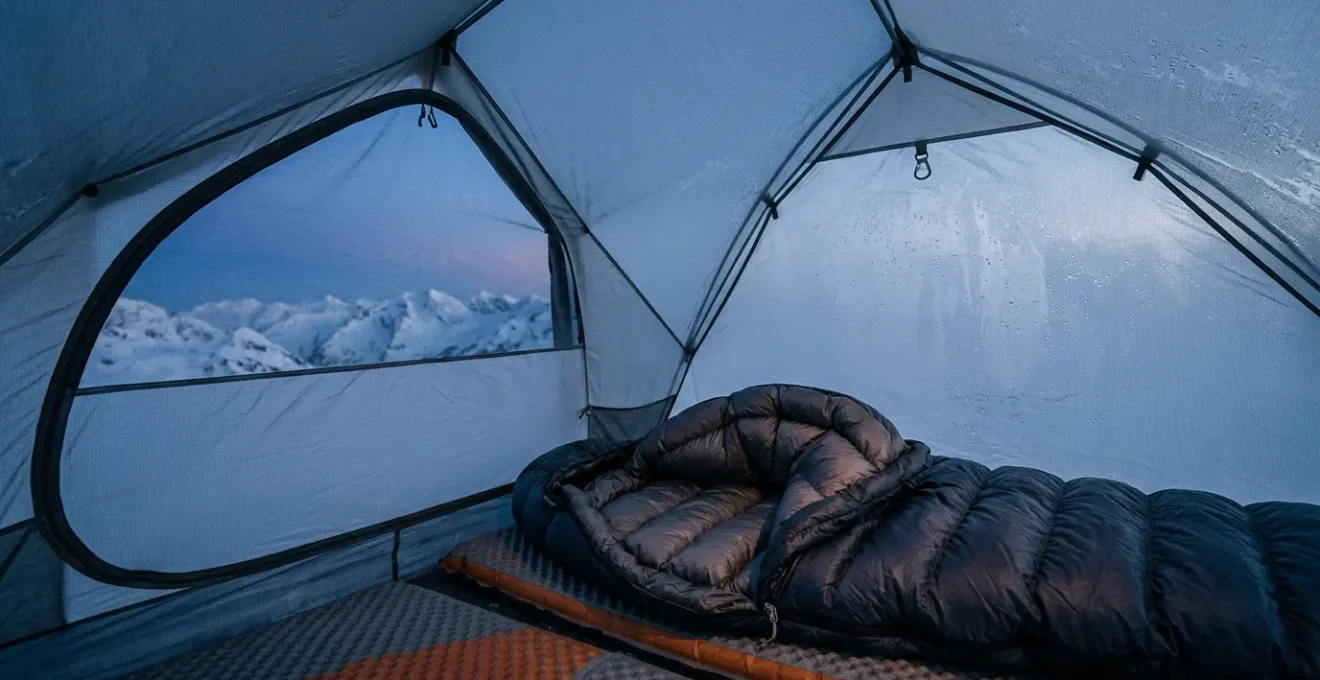
The temperature rating on your sleeping bag is not a guarantee of comfort; it’s a lab-tested survival metric that fails without understanding the complete thermal system.
- Heat is primarily lost to the cold ground (conduction), not the air. Your sleeping pad’s R-value is more critical than your bag’s fill power.
- Improper layering creates sweat (« internal rain ») that can lead to hypothermia, even inside a warm bag.
- Long-term compression storage permanently damages insulation (loft), destroying its ability to trap heat.
Recommendation: Stop focusing on the bag’s rating and start mastering your sleep system as a whole—your pad is your foundation, your layers manage moisture, and your bag traps the heat you protect.
There’s a universally frustrating moment for every camper: shivering in the pre-dawn cold, cocooned in a sleeping bag that was supposedly rated for these exact temperatures. You followed the common advice—you bought a quality bag, maybe you even wore socks to bed. Yet, the cold seeps in, relentless and demoralizing. This experience often leads campers to a single, expensive conclusion: « I need a warmer, bulkier bag. » But this chase for a lower temperature rating is often a fool’s errand.
The conventional wisdom about staying warm is incomplete. It focuses on the sleeping bag as an isolated object, a magical heat generator. The truth is far more rooted in physics. Your body is the furnace; the sleeping bag is merely the insulation for the house. And if that house has no foundation, a leaky roof, and drafty windows, even the best furnace will fail. The real key to warmth isn’t about adding more insulation, but about scientifically preventing heat loss.
This guide reframes the problem entirely. We will move beyond the marketing number on the tag and dissect the complete thermal system. We will wage a targeted battle against the three ways your body loses heat: conduction (to the ground), convection (through air movement), and evaporation (from your own sweat). By understanding and defeating these thermal enemies, you can unlock the true potential of the gear you already own and sleep warmly, even when the mercury plummets.
In the following sections, we’ll deconstruct the myths around temperature ratings, reveal the maintenance mistakes that cripple performance, and build your sleep system from the ground up—literally. Prepare to transform your cold nights into comfortable ones.
Contents: A Systemic Approach to Staying Warm
- Why temperature ratings are survival limits, not comfort guarantees?
- How to wash a down bag without clumping the feathers?
- The storage mistake that ruins loft and warmth permanently
- Mummy vs Rectangular: Which shape is better for restless sleepers?
- How to use a liner to add 5°C of warmth cheaply?
- The layering mistake that causes hypothermia inside a sleeping bag
- Why the ground sucks heat 3x faster than the air?
- Sleeping Mats: Why Your Expensive Bag Fails without the Right R-Value?
Why temperature ratings are survival limits, not comfort guarantees?
The number printed on your sleeping bag’s tag feels like a promise, but it’s actually a highly standardized scientific measurement, not a real-world comfort guarantee. The globally recognized ISO 23537 testing standard provides three ratings: Comfort, Limit, and Extreme. The number most brands advertise is often the « Limit »—the temperature at which a « standard man » can sleep curled up for eight hours without waking from cold. The « Comfort » rating, for a « standard woman » in a relaxed posture, is often several degrees warmer and a far more realistic guide for most users.
These ratings are determined in a controlled lab using a heated mannequin dressed in base layers. To ensure consistency, this mannequin is equipped with 15 temperature sensors and placed on a standardized, insulated surface. This process is excellent for comparing Bag A to Bag B under identical conditions. However, it completely removes the single most important variable: you. Your personal metabolism, hydration level, fatigue, and even what you ate for dinner dramatically affect your ability to generate heat.
As the experts at Alpenglow Adventure Sports point out, the variables are nearly endless:
The complexity of sleeping bag temperature ratings stems from the many variables that affect human thermal comfort during sleep. Individual metabolism, body composition, age, fitness level, hydration, nutrition, fatigue, and even psychological state all influence how warm or cold you’ll feel in any given sleeping bag.
– Alpenglow Adventure Sports, Sleeping Bag Temperature Ratings Explained: What Do You Really Need?
Therefore, you must treat the rating as a starting point in a larger equation. It’s a piece of lab data, not a field-tested promise. The rest of the equation involves how you maintain your bag’s insulation and, most critically, how you prevent your body’s heat from being stolen by the environment.
How to wash a down bag without clumping the feathers?
A sleeping bag’s warmth comes from « loft »—the ability of its insulation (especially down) to trap pockets of still air. Dirt, body oils, and grime slowly compromise this loft, causing the delicate down clusters to stick together and reducing their insulating power. Washing your bag is essential maintenance, but doing it incorrectly can cause permanent clumping and ruin its performance. The key is a gentle wash followed by a long, patient, and meticulous drying process.
The primary goals are to use a cleaner designed specifically for down, which won’t strip the feathers of their natural oils, and to ensure every last bit of moisture is removed during drying. Wet down clumps are the enemy. They must be broken up manually both before and during the drying cycles. This is the most critical step where most people fail, pulling a bag out of the dryer that feels dry on the surface but contains hidden, damp clumps that will breed mildew and never loft again.
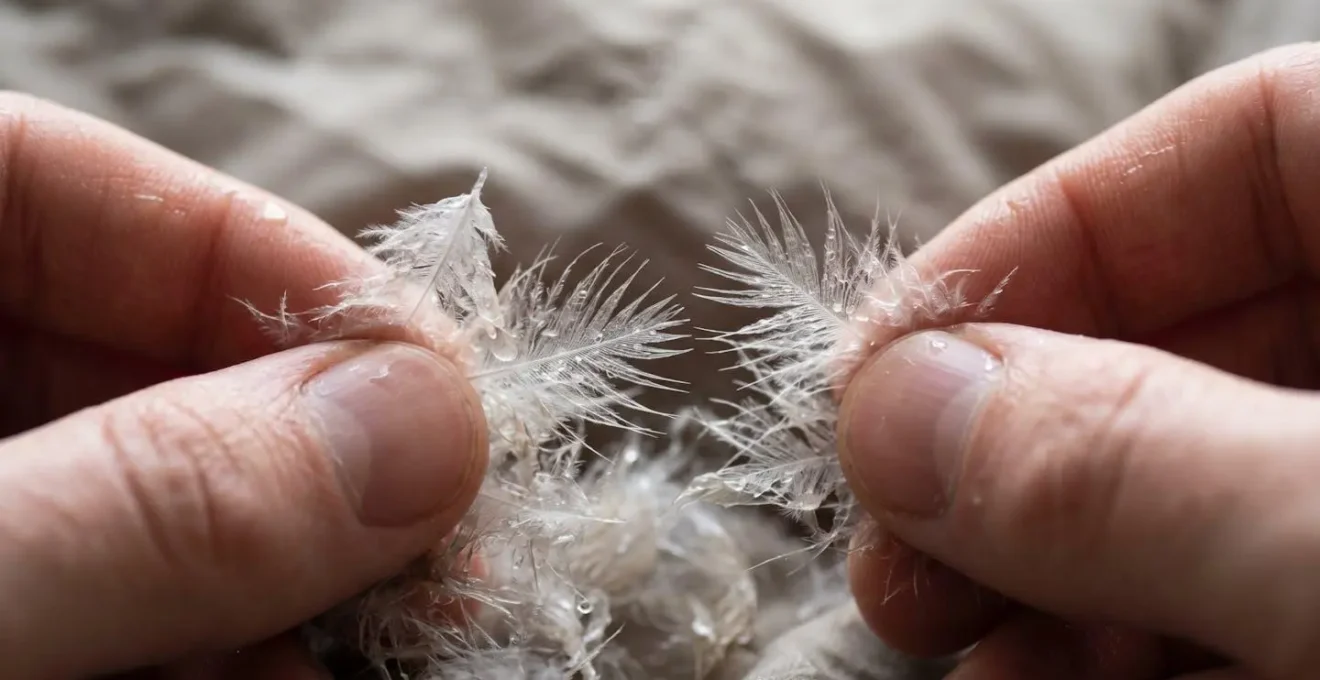
As the image above illustrates, the process is tactile. You must feel for these dense, wet clumps and gently tease them apart. The use of tennis balls or dryer balls is crucial; they act as automated « fluffers, » continuously breaking up the down as it tumbles. Patience is your greatest tool here; a proper drying process can take several hours and multiple cycles.
Action Plan: Clump-Free Down Bag Washing
- Machine & Soap Prep: Use a large, front-loading washer (no agitator). Select a gentle/delicate cycle with cold water and add a specialized down soap, following the instructions carefully.
- Rinse Thoroughly: Run at least two full rinse cycles to remove all soap residue, which can inhibit lofting.
- Initial De-Clumping: Before drying, gently squeeze out excess water (do not wring!). Lay the bag flat and manually break apart the largest, most obvious clumps of wet down with your fingertips.
- The Drying Gauntlet: Place the bag in a large dryer on a low or no-heat setting. Add 2-3 clean tennis balls or wool dryer balls to help break up the down.
- Cycle & Fluff: Run the dryer for a full cycle. Remove the bag, let it cool completely (damp spots are easier to find on cool fabric), and manually find and break up any remaining clumps. Repeat this process until the bag is 100% dry and evenly lofty, which may take 3-5 cycles.
The storage mistake that ruins loft and warmth permanently
Every new sleeping bag comes with two sacks: a small compression stuff sack for the trail and a large, breathable storage sack for home. The single most destructive thing you can do to your bag’s long-term performance is to store it in the small stuff sack. While convenient for packing, prolonged compression physically damages the insulation, whether it’s down or synthetic.
Insulation works by creating thousands of tiny air pockets. The « loft » or thickness of your bag is a direct measure of how much air it can trap. When you compress a bag, you’re squeezing all the air out and crushing the delicate structures of the fill. Over time, these structures lose their « memory » and ability to spring back. Down feathers can break, and synthetic filaments can develop permanent crimps. This loss of loft is irreversible. No amount of fluffing will ever fully restore it, meaning your -5°C bag might permanently become a 0°C bag.
The damage is not theoretical; it’s a measurable degradation of performance that accumulates over time. Think of it like a sponge: you can compress it for a short time and it will bounce back, but if you leave a heavy weight on it for a year, it will be permanently flattened.
Field Study: The 15-Year Compression Test
A fascinating long-term field study documented on Backpackinglight.com compared two identical 15-year-old sleeping bags. One was always stored loose in its large mesh sack. The other was left in its compression stuff sack for just two of those years. Even after being removed and allowed to air out and fluff for multiple days, the chronically compressed bag struggled to regain its full loft. It was visibly thinner and less puffy than its properly-stored counterpart, a clear demonstration that prolonged compression inflicts measurable, lasting damage on the insulation’s structure.
The correct way to store your bag is to ensure it is completely dry after a trip, then place it in its large mesh or cotton storage sack. Alternatively, you can hang it in a closet. The goal is to allow the insulation to remain as uncompressed as possible, preserving its loft and ensuring it’s ready to perform for years to come.
Mummy vs Rectangular: Which shape is better for restless sleepers?
The shape of your sleeping bag is a critical factor in the battle against convective heat loss—the process of cold air replacing the warm air your body has heated up. The two primary shapes, mummy and rectangular, offer a direct trade-off between thermal efficiency and spaciousness. For a restless sleeper, the choice might seem counter-intuitive. One might assume the extra room of a rectangular bag is better for tossing and turning.
However, from a thermal dynamics perspective, all that extra space is a liability. Every time you move in a roomy rectangular bag, you are acting like a pump. The empty volume around your body is filled with precious warm air that you’ve spent energy heating. As you shift, this air is forced out of the bag’s opening and is immediately replaced by cold, ambient air, which your body must then start heating from scratch. This constant exchange of air is a massive energy drain.
A well-fitting mummy bag, by contrast, is designed to move *with* you. Its form-fitting shape minimizes « dead air space, » the volume of air that needs to be heated. When a restless sleeper turns, the bag turns with them, keeping the sealed pocket of warm air intact. As one analysis vividly puts it:
A restless sleeper in a loose, rectangular bag acts like a bellows, pumping warm air out and sucking cold air in with every movement. A mummy bag that moves with you minimizes this air exchange.
– Outdoor Gear Testing Community, Sleeping Bag Design and Thermal Efficiency Analysis
For cold conditions, a mummy bag is almost always the superior choice for thermal performance, especially for those who move a lot in their sleep. The perceived comfort of extra space in a rectangular bag comes at a steep thermal cost, forcing your body’s furnace to work overtime all night long just to keep up with the constant convective heat loss.
How to use a liner to add 5°C of warmth cheaply?
A sleeping bag liner is one of the most versatile and cost-effective upgrades to your sleep system. It’s a thin, removable inner layer that offers two primary benefits: it significantly boosts warmth and it keeps your sleeping bag clean, reducing the need for the risky washing process we detailed earlier. The amount of warmth a liner adds depends entirely on its material, ranging from a couple of degrees to a massive boost that can turn a 3-season bag into a winter-capable one.
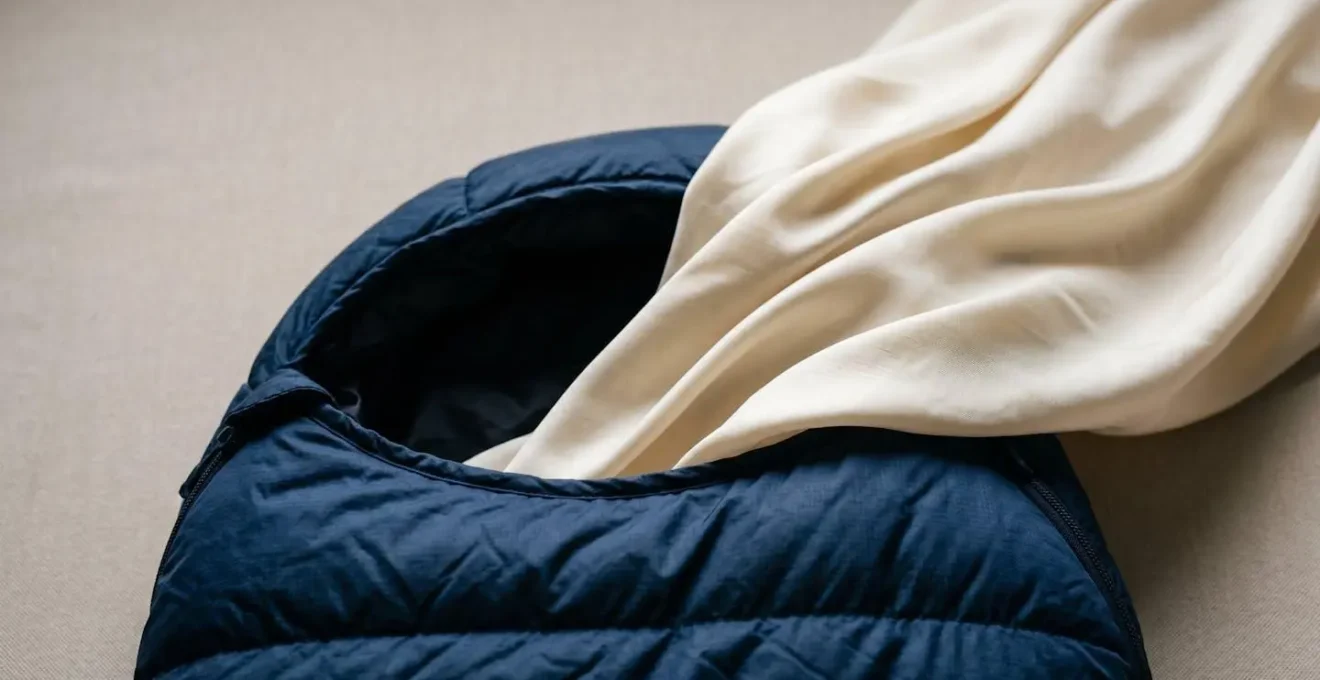
The liner acts as an additional layer of trapped air between your body and the bag’s primary insulation. Some materials, like Thermolite, use hollow-core fibers or infrared-reflecting technology to actively increase thermal efficiency. Others, like fleece, provide straightforward insulation, while silk offers surprising warmth for its incredibly low weight and bulk. Beyond warmth, the hygiene benefit is huge. It’s far easier to wash a small liner after every trip than it is to wash the entire sleeping bag.
The following table, based on data from sleep system experts like industry leader Sea to Summit, breaks down the performance of common liner materials. This allows you to choose a liner that perfectly matches your goals, whether it’s a lightweight boost for a summer trip or a major thermal upgrade for shoulder-season camping.
| Liner Material | Temperature Boost | Weight | Best Use Case | Moisture Management |
|---|---|---|---|---|
| Silk | 5-8°F (3-4°C) | Ultra-light (3-5 oz) | Lightweight travel, warm weather comfort | Moderate wicking |
| Fleece | ~10°F (5-6°C) | Medium (8-12 oz) | Static warmth in dry cold conditions | Low wicking |
| Thermolite Reactor | Up to 15°F (8°C) | Light (6-8 oz) | Infrared-reflecting fibers for measurable boost | Excellent wicking |
| Thermolite Extreme | Up to 25°F (14°C) | Medium-heavy (10-14 oz) | Extreme cold extension without buying new bag | Excellent wicking |
| Cotton | 3-5°F (2-3°C) | Heavy (12-16 oz) | Hostel/indoor use, hygiene focus | Poor (absorbs moisture) |
By selecting the right liner, you can effectively lower your sleeping bag’s comfort rating by 5°C or more for a fraction of the cost of buying a new bag. It’s a modular approach that allows you to adapt your single sleeping bag to a much wider range of temperatures.
The layering mistake that causes hypothermia inside a sleeping bag
When feeling cold, the intuitive response is to pile on more clothes. Inside a sleeping bag, however, this logic can backfire spectacularly. The most dangerous layering mistake is wearing too much or wearing the wrong materials, which leads to the third type of heat loss: evaporative heat loss. Your body is always emitting moisture, even when you don’t feel like you’re actively sweating. If this moisture gets trapped against your skin or in your clothes, your body must expend a massive amount of thermal energy to evaporate it, actively cooling you down.
Wearing non-breathable layers, like a rain jacket, or too many layers of insulating clothing (like a down puffy) inside your bag is a recipe for disaster. You will inevitably start to sweat. This moisture saturates the clothing and the bag’s insulation around you, crushing its loft and replacing precious pockets of trapped air with heat-sucking water. Experts call this dangerous feedback loop « internal rain. »
Wearing too many layers or a waterproof jacket to bed causes you to sweat. This moisture becomes trapped, and your body then spends massive energy trying to evaporate it, leading to a rapid chill—a phenomenon known as ‘internal rain’.
– Sleep System Experts, Advanced Cold Weather Sleep Strategies
The correct strategy is to wear a single, dry base layer made of a moisture-wicking material like merino wool or a technical synthetic. These fabrics pull moisture away from your skin and allow it to pass through the breathable insulation of your sleeping bag to the outside air. Cotton is the absolute worst choice; it acts like a sponge, holding moisture against your skin and accelerating heat loss. It’s better to sleep with fewer layers of the right material than too many layers of the wrong one.
In extreme polar expeditions, experts use a counter-intuitive technique called a Vapor Barrier Liner (VBL). This is a completely non-breathable layer worn against the skin to stop *all* sweat from reaching the insulation, keeping it bone-dry on multi-week trips. While effective, it’s a highly advanced and often uncomfortable technique that illustrates just how critical moisture management is to the thermal system.
Why the ground sucks heat 3x faster than the air?
Of the three types of heat loss, the one that robs you of warmth most aggressively is conduction: the direct transfer of heat from your body to the ground. You could have the most expensive, loftiest sleeping bag in the world, but the part you are lying on is useless. Your body weight compresses the insulation beneath you, eliminating virtually all its loft and, therefore, its ability to trap air. Without that trapped air, you have a direct thermal bridge to the cold ground.
The ground is a far more effective « heat sink » than the air. Water transfers heat about 25 times faster than air, and dense, damp ground can suck the warmth from your body at an alarming rate. Even on a night where the air temperature is a mild 10°C, the ground temperature can be significantly colder. According to thermal dynamics research, frozen ground below 0°C acts as an infinite heat sink, capable of absorbing all the heat your body can produce without its own temperature rising.
This is the single most misunderstood concept in sleeping-bag warmth. People invest hundreds of dollars in a bag with high-tech down fill, not realizing that the moment they lie on it, the entire bottom half of their investment is rendered inert. As the Sea to Summit technical team bluntly states:
Your body weight compresses the bottom of your sleeping bag, eliminating its loft and insulation value. This means that no matter how expensive your bag is, its bottom insulation is effectively zero without a pad.
– Sea to Summit Technical Team, Sleep System Performance Guide
This is why your sleeping pad is not an accessory for comfort; it is the foundation of your entire thermal system. It is the only thing preventing catastrophic conductive heat loss to the ground. No matter how good your bag is, it will fail if the foundation it rests on is not properly insulated.
Key Takeaways
- Ratings are a Lab Standard, Not a Field Promise: Your personal metabolism and the rest of your gear determine real-world comfort, not just the number on the tag.
- Loft is Warmth: Protect your bag’s insulation. Wash it correctly to prevent clumping and store it uncompressed to avoid permanent damage.
- The Pad is the Foundation: Your sleeping pad provides the crucial insulation against the ground (conduction), without which your expensive bag’s bottom insulation is useless.
Sleeping Mats: Why Your Expensive Bag Fails without the Right R-Value?
Since the ground is the primary thief of your body heat, your sleeping pad is your primary shield. But not all pads are created equal. The measure of a pad’s ability to resist heat flow is called its R-value. A higher R-value means better insulation. This is not a marketing term; it’s a standardized, scientifically tested measurement that is the single most important specification for your entire sleep system.
Using a pad with an R-value of 1 on a cold night is like trying to heat your house in winter with all the windows open. It doesn’t matter how powerful your furnace (your body) or how thick your attic insulation (your sleeping bag) is; you’re losing heat through the floor faster than you can generate it. The required R-value is directly tied to the ground temperature, and ASTM testing standards provide clear guidelines: a value of 1-2 is for summer use, while true winter camping on frozen ground requires an R-value of 5 or greater.
Here is the critical piece of information that ties the entire system together: the official ISO 23537 sleeping bag temperature rating test is conducted with the mannequin lying on a sleeping pad with an R-value of 5.38. This means that if you use your -5°C bag with a cheap, uninsulated foam pad (R-value ~1.5), you will *never* achieve that -5°C performance in the real world. You have fundamentally broken the system that was used to generate the rating in the first place.
Your sleeping pad and your sleeping bag are not two separate items; they are two halves of a single system. Your bag provides insulation for the top and sides, while your pad provides the essential insulation for the bottom. Neglecting the R-value of your pad is the number one reason why people feel cold in high-quality sleeping bags. It’s the missing link that explains countless shivering nights.
Stop blaming your bag for cold nights. Take control of your entire thermal system—from the ground up—and master the physics of warmth on your next adventure.