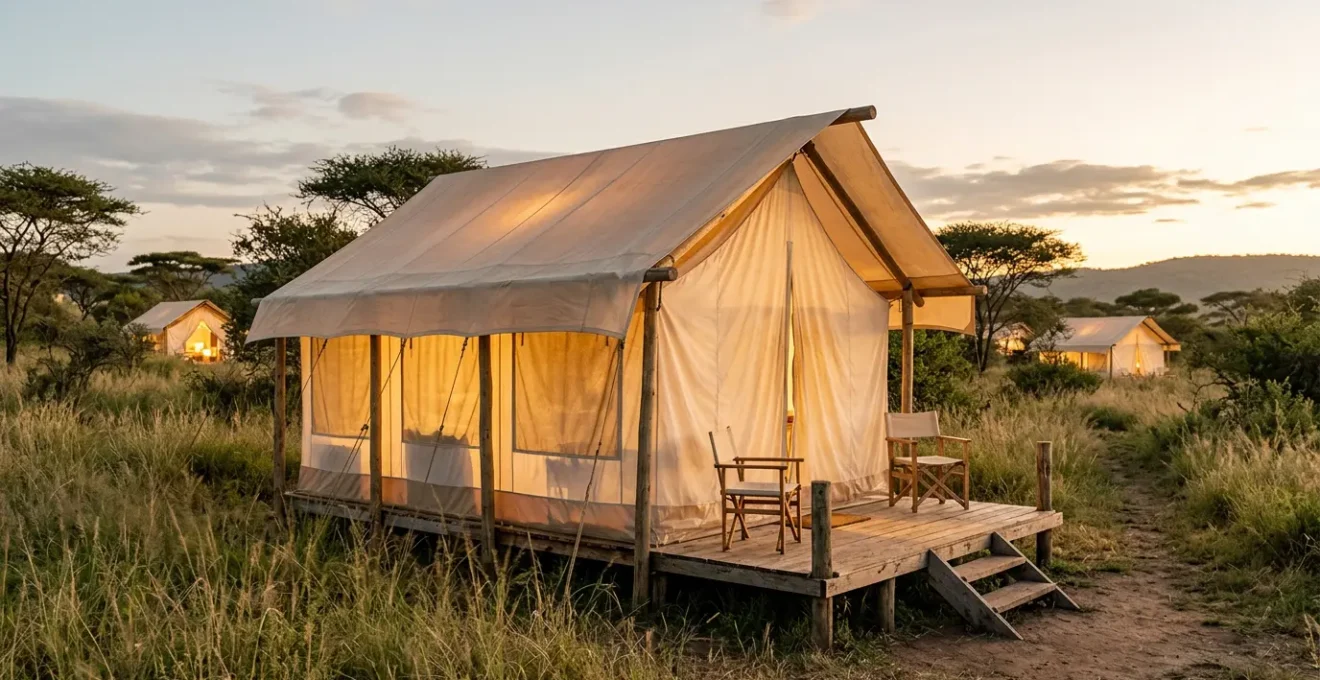
The hard truth: a canvas wall offers virtually no soundproofing against conversations, regardless of its thickness.
- Acoustic privacy in a safari tent is not achieved through the tent’s material but by managing distance, ambient noise, and site layout.
- Features like en-suite bathrooms and even noisy air conditioners become strategic tools for ensuring intimacy.
Recommendation: Instead of searching for a « soundproof » tent, focus on choosing a site with strategic spacing and use our actionable tips to create your own bubble of privacy.
The allure of glamping is undeniable, especially for couples seeking a romantic escape. You get the immersion in nature without sacrificing the comfort of a real bed and amenities. But a nagging question often spoils the fantasy: with only a layer of canvas between you and your neighbors, is any real privacy possible? The fear of hearing every word from the next tent—and being overheard yourselves—is a significant concern that can undermine the entire experience of intimacy you’re seeking.
Many will offer simple advice like « pick a quiet site » or « look for tents that are far apart. » While not wrong, this guidance ignores the fundamental physics of sound. As an acoustics specialist, my goal is to give you a realistic and honest assessment. The key to ensuring privacy isn’t about finding a magical, soundproof canvas, because one doesn’t exist. It’s about understanding how sound behaves in an outdoor environment and using that knowledge to your advantage.
This article will shift your perspective. We won’t be chasing the myth of a silent tent. Instead, we will break down the science of sound transmission through fabric, analyze the critical role of distance and ambient noise, and evaluate how site features like air conditioning and bathroom placement dramatically impact your acoustic privacy. By the end, you’ll be equipped with a practical framework for planning a romantic glamping trip where you can truly feel secluded.
This guide will walk you through the key acoustic factors to consider. By understanding these principles, you can make informed choices and reclaim the sense of intimacy that a nature escape should offer.
Summary: The Acoustic Reality of Safari Tents
- Why Canvas Offers Zero Decibel Reduction Compared to Wood
- How Many Meters of Distance Are Needed for Conversation Privacy?
- The AC Unit Noise: When Comfort Kills the Nature Soundtrack
- En-suite vs Shared Block: Does It Reduce Foot Traffic Noise?
- When « Quiet Hours » Are Enforced: Glamping vs Camping Distinct Rules
- Why Aggressive Confrontation Escalates Noise Rather Than Stopping It?
- Yurt or Geodesic Dome: Which Structure Offers Better Insulation in Winter?
- How to Plan a Romantic Camping Trip That Actually Rekindles Intimacy
Why Canvas Offers Zero Decibel Reduction Compared to Wood
To understand why a safari tent feels so different from a cabin, we need to talk about a core principle in acoustics: acoustic mass. In simple terms, to block sound, you need heavy, dense, and rigid materials. Sound is a pressure wave, and it easily causes thin, flexible materials like fabric to vibrate, passing the sound energy straight through. A thick, heavy wall resists this vibration, reflecting or absorbing the sound energy instead.
The industry measures this ability with a Sound Transmission Class (STC) rating. A higher STC rating means better sound insulation. From a physics perspective, canvas has an STC rating close to zero. It lacks the mass to be an effective sound barrier. For comparison, a typical interior wall has an STC of 35-55, which is enough to make loud speech largely unintelligible. The « luxury » or « heavy-duty » canvas of a safari tent might be great for weatherproofing, but it does not fundamentally change this acoustic reality.
What this means in practice is that any normal-to-loud conversation will travel through a canvas wall with very little reduction in volume. You must assume that if you can hear your neighbors clearly, they can hear you too. The solution to privacy, therefore, lies not in the material of the tent itself, but in the other factors we will explore.
How Many Meters of Distance Are Needed for Conversation Privacy?
Since the canvas itself offers no real barrier, your primary tool for privacy becomes distance. Sound energy dissipates over distance in the open air, a principle known as the inverse-square law. For every doubling of distance from the sound source, the perceived sound level drops by approximately 6 decibels. This is a significant and noticeable reduction. While there’s no magic number, a good rule of thumb is to aim for at least 15-20 meters (50-65 feet) of separation between tents for a reasonable expectation of conversational privacy during the day.
This distance allows normal conversation to fade into the ambient background noise of the environment. At night, when the background noise level drops, this distance becomes even more critical. Visual barriers like trees and dense shrubbery can help, but their effect is often more psychological than acoustical. They scatter high-frequency sounds but do little to block the lower-frequency range of human voices.

As the illustration suggests, open space is your best ally. When booking a glamping site, don’t just look at photos. Study the site map or, even better, call the property and ask for the specific distance between units. A site with tents clustered 5 meters apart will offer a fundamentally different—and far less private—experience than one with 20 meters of separation, regardless of how luxurious the tents are.
The AC Unit Noise: When Comfort Kills the Nature Soundtrack
Many campers see a window air conditioning unit as a necessary evil—a source of noise that detracts from the peaceful sounds of nature. However, from an acoustic perspective, that constant hum can be your greatest asset for privacy. This introduces the concept of sound masking. While sound *blocking* (like a brick wall) stops sound from passing through, sound *masking* introduces a steady, unobtrusive background noise that makes other sounds (like conversations) harder to decipher.
The gentle, broadband noise of an AC fan is an excellent sound masker. It effectively raises the « noise floor » of the environment, making your private conversations blend into the background. Your neighbors won’t be able to pick out individual words because the AC’s hum is covering them up. It creates a « bubble » of acoustic privacy around your tent. So, that noisy AC unit isn’t killing intimacy; it might actually be enabling it.
Some tent manufacturers are leaning into this idea. While the physics of canvas remains, insulated safari tents with acoustic technology aim to muffle some sound transfer. This is often achieved with layered fabrics that dampen high-frequency noise, but the primary benefit still comes from external factors like a masking sound source. When you see a tent with an AC unit, don’t just think of it as a cooling device; see it as a privacy feature.
En-suite vs Shared Block: Does It Reduce Foot Traffic Noise?
Airborne sound (like conversations) is only one part of the equation. The other is structure-borne vibration. This is noise that travels through physical objects. In a glamping site, the most common source is the wooden decking or platform that many safari tents are built upon. If your tent shares a large, continuous deck with its neighbors, every footstep, every scraped chair, and every dropped item can travel through the structure and be heard and felt in your space.
This is where the choice between an en-suite bathroom and a shared wash block becomes an important acoustic decision. A tent with en-suite facilities eliminates the need for you or your partner to walk across a shared (and often creaky) wooden platform late at night. This single factor can drastically reduce a major source of disruptive, structure-borne noise during the hours when you most desire peace and quiet.

Choosing a tent on a separate, isolated platform is the ideal scenario. The physical break in the decking material stops vibrations from transferring between units. If all tents are on one large, connected structure, a unit at the end of the line will be quieter than one in the middle with foot traffic passing on both sides. Therefore, an en-suite tent isn’t just a luxury; it’s a practical choice for minimizing a very specific and often overlooked type of noise disturbance.
When « Quiet Hours » Are Enforced: Glamping vs Camping Distinct Rules
Every shared accommodation relies on a social contract, and « quiet hours » are its most common expression. But are they just a suggestion on a sign, or a rule with real teeth? The good news is that they are generally effective. For most properties, quiet hours start around 10:00 pm and end at around 7:00 am, which covers the critical period for sleep and intimacy.
More importantly, enforcement is often simpler than you might think. Most people don’t want to be disruptive. In many cases, a single, polite request is all that’s needed to resolve a noise issue. In fact, statistics from property management enforcement data show that about 65% of noise complaints get resolved at the first warning stage. This holds true for campsites as well.
There is also a cultural distinction to consider. Glamping sites often operate more like hotels than traditional campgrounds. They are typically staffed with a host or manager whose job includes ensuring guest comfort. This service-oriented model means you have a clear and non-confrontational path to resolving a noise issue: simply text or call the front desk. They are incentivized to handle the situation discreetly and effectively to protect their reputation and reviews. This is a significant advantage over a primitive campground where you might be left to deal with a noisy neighbor on your own.
Why Aggressive Confrontation Escalates Noise Rather Than Stopping It?
If you do encounter a noisy neighbor, your approach is everything. Marching over and aggressively demanding they be quiet is almost guaranteed to backfire. This triggers a psychological principle known as reactance. When people feel their freedom or autonomy is being threatened, their instinctive reaction is to resist and reassert their freedom—in this case, by being just as loud, if not louder.
Your goal is de-escalation and cooperation, not conflict. An angry confrontation puts the other party on the defensive, making them far less likely to comply. Instead, a calm, polite, and empathetic approach yields much better results. This isn’t just a social nicety; it’s a proven strategy. For instance, counseling research demonstrates that therapists using respectful, choice-oriented approaches rather than direct confrontation achieve significantly higher client willingness to change.
The same logic applies here. Frame your request as a shared problem. A simple, « Hey, sorry to bother you, but the walls here are paper-thin and we’re trying to get some sleep. Would you mind keeping it down a bit? » is infinitely more effective than an angry shout. It’s non-accusatory and makes them a partner in the solution. If that fails, your next step should always be to contact the site manager, not to escalate the confrontation yourself.
Yurt or Geodesic Dome: Which Structure Offers Better Insulation in Winter?
When considering alternatives to a safari tent, structures like yurts and geodesic domes often come up, especially for winter camping. The question is, are they acoustically superior? The answer is nuanced and lies in the layers. While the shape (round vs. dome) has a minor impact on how sound reflects internally, the key difference is in the construction of the walls. These structures are often built with multiple, distinct layers specifically for thermal insulation.
A typical yurt wall, for example, might consist of an outer weatherproof canvas, a thick layer of felt or wool insulation, and a decorative inner fabric liner. This multi-layer system is excellent at trapping air and providing thermal insulation, keeping you warm in the winter. Acoustically, these soft, thick layers are very good at absorbing high-frequency sounds—think of the sharp sound of a clicking pen or rustling leaves.

However, this construction still lacks the sheer acoustic mass needed to block lower-frequency sounds like the bass from a stereo or the murmur of a deep conversation. The layers will « muffle » the sound and make it less clear, which is an improvement over a single-layer safari tent, but it is not true soundproofing. So, while a yurt or insulated dome will offer a noticeable improvement in acoustic comfort by dampening sharp noises and providing a cozier feel, you should still operate under the assumption that loud conversations can be overheard.
Key Takeaways
- Canvas has no acoustic mass; do not rely on the tent itself for soundproofing. It’s a weather barrier, not a sound barrier.
- Your most effective tools for privacy are distance (aim for 15+ meters) and sound masking (using an AC unit or a white noise app).
- Choose your site strategically: prioritize en-suite facilities to avoid structure-borne noise and use the site manager to handle any noise issues.
How to Plan a Romantic Camping Trip That Actually Rekindles Intimacy
Achieving true privacy and intimacy on a glamping trip isn’t a matter of luck; it’s a matter of proactive, strategic planning. By now, you understand that the canvas walls are acoustically transparent. Instead of worrying about that, you can now focus your energy on the factors you can actually control. It’s about designing your acoustic environment just as carefully as you choose your destination.
This means shifting your research from « most luxurious tent » to « best site layout for privacy. » It means seeing an AC unit not as a bug but as a feature. It means having a simple, non-confrontational plan ready in the unlikely event you have noisy neighbors. When you take control of these elements, you eliminate the anxiety of being overheard and create the secure, private space needed for romance to flourish. The following steps will turn this knowledge into a concrete plan.
Action Plan: Your Checklist for Acoustic Privacy
- Research site layout before booking: Call the property to ask specific questions about tent spacing, visual barriers, and natural sound buffers between accommodations.
- Bring portable white noise solutions: A high-quality speaker playing ambient sounds (rain, forest) at low volume masks private conversations and creates a sound privacy bubble.
- Use carpets or fluffy rugs inside the tent: Their fibers trap sound waves, reducing internal echo and absorbing airborne sounds from conversations.
- Choose strategic timing: Plan intimate moments during periods of natural ambient noise (afternoon when others are active, windy weather, or rain) when background sounds provide natural masking.
With this practical knowledge, you can move past the fear of thin walls. True intimacy comes from feeling safe and uninhibited, and a well-planned trip can create that sanctuary, even with only canvas for a wall.
Now you have the expert knowledge to look beyond the marketing photos and analyze a glamping site like an acoustician. Take control of your acoustic environment and confidently book the romantic, private escape you’ve been dreaming of.