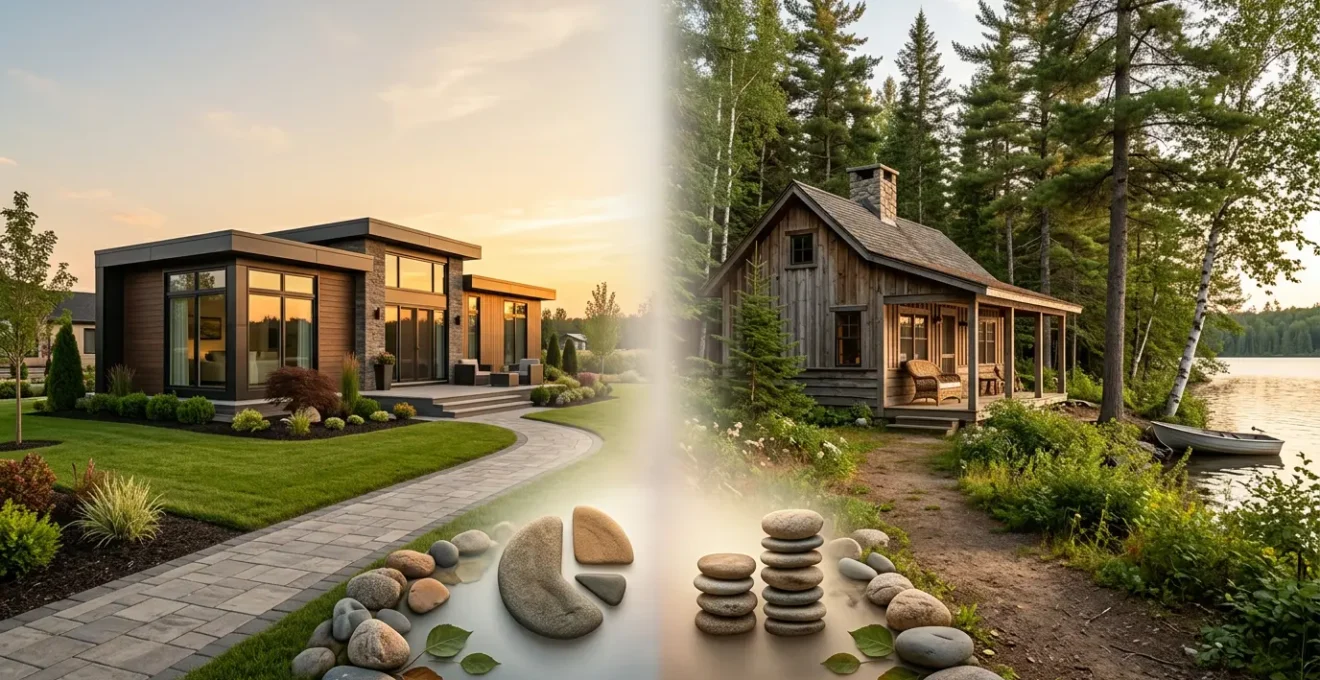
A luxury mobile home can outperform a traditional cottage as an investment, but only if you master its unique financial risks.
- The primary risk isn’t just depreciation, but unregulated site fees and restrictive park contracts that erode equity.
- Appreciation is possible, but it depends entirely on securing a home on owned or highly desirable, resort-style land.
Recommendation: Treat the purchase like a business acquisition: conduct deep due diligence on the park’s contract and your exit strategy before ever considering the home itself.
The vision of a personal retreat—a quiet, comfortable space away from the daily grind—often leads potential investors to a classic crossroads: the traditional summer cottage versus the modern luxury mobile home. For many, the cottage represents a tangible piece of real estate, a seemingly secure investment in land and property that promises appreciation over time. The luxury mobile home, on the other hand, offers resort-style living at a fraction of the upfront cost, complete with high-end finishes and community amenities.
Conventional wisdom dictates a clear financial winner. Cottages appreciate; mobile homes depreciate. This simple binary has guided decisions for decades. But what if this framework is dangerously outdated? The modern luxury mobile home market, with its focus on build quality and premium locations, challenges this assumption. Simultaneously, the rising costs of cottage ownership—from property taxes to insurance and relentless maintenance—can quietly devour any gains from appreciation.
The true determinant of a « smarter » investment is no longer the asset class itself. Instead, it lies in an investor’s ability to identify and manage the hidden liabilities unique to each option. The real question is not « cottage or mobile home? » but « can you master the contractual traps of park life, or can you stomach the total cost of occupancy of a standalone property? »
This guide provides the financial due diligence framework to answer that question. We will dissect the financial DNA of a luxury mobile home investment, moving beyond simple price tags to analyze the critical factors that determine its true long-term value: depreciation mechanics, contractual risks, build quality, exit strategies, and the compounding effect of site fees.
Summary: The Definitive Investor’s Guide to Luxury Mobile Homes vs. Cottages
- Why mobile homes depreciate like cars, not like houses?
- How to spot « forced upgrade » clauses in campground contracts?
- The wall thickness check that guarantees comfort in December
- Resale on site vs Removal: Which exit strategy loses less money?
- When do site fees exceed the cost of property taxes?
- How to book exclusive glamping sites 6 months in advance without paying premium?
- How to negotiate long-stay rates for a month of silence?
- Bungalow Parks: How to Choose a Quiet Location in a Busy Resort?
Why mobile homes depreciate like cars, not like houses?
The fundamental financial hurdle for any mobile home investment is depreciation. Unlike traditional real estate where the land value typically appreciates, a mobile home is classified as personal property, much like a vehicle. This distinction is critical. The asset’s value is untethered from the land it sits on, leading to an immediate and often steep decline in worth. Industry data suggests a new manufactured home can lose 10-20% of its value in the first year alone.
This financial behavior is rooted in its legal status. As financial advisory firm Ramsey Solutions points out in their investment analysis:
This steep decline occurs because a manufactured home is considered personal property, not real estate, and it lacks the land value that usually contributes to appreciation.
– Ramsey Solutions, Mobile Homes Investment Analysis
However, the « luxury » segment of the market can defy this rule under specific conditions. The key is to re-link the home to appreciating land and desirable amenities. When a high-end mobile home is situated in a premium location with resort-style features on land that is either owned or part of a highly sought-after community, it can behave more like traditional real estate. This exception proves the rule: value follows the land and the lifestyle, not the structure alone.
Case Study: Beating Depreciation in a Resort Community
Jackie Adkins purchased a luxury manufactured home in a resort community in Ocean City, Maryland, in 2019 for $160,000. The home features three bedrooms, two baths, and high-end finishes. Crucially, the community offers significant amenities and is in a prime coastal location. By 2024, her home’s value had appreciated to nearly $300,000. This example, detailed in a GoBankingRates analysis, demonstrates that when a mobile home is inextricably linked to desirable land and amenities, it can overcome its personal property status and appreciate significantly.
How to spot « forced upgrade » clauses in campground contracts?
Beyond depreciation, the single greatest financial risk in a mobile home investment is the park contract. This document is not merely a set of rules; it’s a financial instrument that can dictate unforeseen expenses and control your asset. The most insidious of these are « forced upgrade » clauses, which empower the park operator to mandate costly improvements to your home or plot at your expense, often under vague « park standards » criteria.
These clauses are designed to maintain a uniform aesthetic across the park, but they can be a significant, unbudgeted liability for homeowners. An operator could decide that all homes must have new skirting, decking, or landscaping by a certain date, forcing you to spend thousands to remain in compliance. Spotting these red flags requires a forensic-level review of the contract before signing.
An investor must scrutinize the language around « periodic reviews, » « site improvement contributions, » and any rules governing the age and condition of homes. A clause that seems benign today could become a major financial burden tomorrow, especially if it’s tied to an uncapped fee escalation structure. Protecting your investment starts with understanding every line of this critical document.
Your Pre-Signature Contract Audit: Key Clauses to Scrutinize
- Review for « periodic review » or « park standards » clauses that allow the operator to mandate upgrades based on subjective criteria.
- Identify « site improvement contribution » fees that can be levied without specific timelines or cost caps.
- Analyze the « right of first refusal » language, which can give the park operator control over your resale process and price.
- Search for escalation clauses without caps; look for phrases like « annual fee increase » without reference to CPI or a specific percentage limit.
- Verify the exact age policy, distinguishing between a hard « 10-year rule » and standards based on the home’s actual condition.
The wall thickness check that guarantees comfort in December
A luxury mobile home’s investment value isn’t just on paper; it’s also measured in year-round comfort and manageable utility bills. A poorly insulated unit is a financial drain, transforming a potential asset into a liability that bleeds cash every winter. The most critical, yet often overlooked, aspect of build quality is the wall, floor, and roof insulation system. It’s the invisible shield that protects your comfort and your wallet.
This image shows a cross-section of a well-constructed mobile home wall, highlighting the layers that work together to provide thermal efficiency.

As the visual demonstrates, it’s not just about thickness. It’s about a complete system including the insulation material, a vapor barrier to control moisture, and proper structural framing. The quality of this system has a direct financial impact. Energy efficiency studies show that better wall insulation can cut heat loss by about 13%, with improved floor insulation reducing it by a further 11%. For an investor, this translates directly to lower operating costs and a higher quality of life, which in turn can command a better resale price.
Therefore, a crucial part of due diligence is to move beyond the cosmetic finishes and demand technical specifications from the manufacturer. You should inquire about not just the wall thickness, but the U-values of the walls and windows (a lower U-value means better insulation) and the R-values of the floor and ceiling insulation. A home built to withstand a cold December is a home built to be a better long-term investment.
Resale on site vs Removal: Which exit strategy loses less money?
Every investment requires a clear exit strategy. For a luxury mobile home, this decision is far more complex than simply listing a property for sale. The two primary paths—reselling the home on its existing plot or removing it for relocation—come with vastly different financial implications. Choosing the right one is critical to minimizing losses and maximizing what value can be recovered from a depreciating asset.
Reselling on-site is often the path of least resistance. It avoids the significant logistical costs of moving the unit. However, this convenience comes at a price. The park operator will typically take a commission of 10-15% on the sale. Furthermore, your pool of potential buyers is restricted to those approved by the park and willing to accept the existing plot lease and its associated fees. This limited market can exert significant downward pressure on your asking price.
Removing the home, on the other hand, opens you up to a wider market of buyers but incurs substantial upfront costs for permits, disconnection, transport, and re-installation. As the following comparison shows, based on an analysis of removal costs, the financial calculus for your exit must be done before you even purchase the home.
| Exit Strategy | Single-Wide Cost Range | Double-Wide Cost Range | Key Considerations | Market Reach |
|---|---|---|---|---|
| Resale On-Site | $0 upfront cost | $0 upfront cost | Park commission typically 10-15%, buyer pool limited to park residents or those willing to rent the plot | Limited to park-approved buyers |
| Professional Removal & Relocation | $3,000 – $8,500 | $5,000 – $15,000 | Includes disconnection, permits, transport, setup. Distance and accessibility major cost factors | Wider market if home is relocatable |
| Demolition & Disposal | $3,000 – $8,500 | $3,500 – $10,000 | Permits $100-$350, labor accounts for 40-60% of cost, landfill fees $40-$80 per ton | Not applicable – complete removal |
| Free Donation/Removal | $0 (if qualifies) | $0 (if qualifies) | Home must be in habitable condition, nonprofit handles removal, provides tax-deductible receipt | No resale value captured |
When do site fees exceed the cost of property taxes?
For a cottage owner, property tax is a predictable, albeit significant, annual expense. For a mobile home investor, the equivalent is the annual site fee, or lot rent. The critical difference is that property taxes are regulated and relatively stable, while site fees can be unpredictable, uncapped, and subject to steep annual increases. This creates a tipping point where the seemingly lower cost of entry for a mobile home is eroded by escalating carrying costs that can eventually surpass the tax burden of a comparable cottage.
This « cost parity » moment often arrives sooner than investors expect, driven by two factors: the park’s revenue model and compounding fee increases. High-amenity resort parks that drive potential appreciation also command the highest fees, and they often include annual escalation clauses of 5-7%. While you avoid a large property tax bill, you are essentially paying a private tax to the park operator—a tax that can rise much faster than official rates. While the home’s value continues to fall, as mobile homes typically lose 3-5% annually, the cost to keep it on the land steadily climbs.
An investor must therefore calculate the Total Cost of Occupancy over a 5-to-10-year horizon, not just the first year. This calculation is essential to make a true apples-to-apples comparison with a cottage, which has its own set of carrying costs (maintenance, insurance, taxes) but benefits from land equity.
Case Study: The High-Amenity, High-Fee Trade-Off
At Pot-Nets Bayside, a resort community near the Delaware beaches, high demand fueled by amenities like pools, a golf course, and a fishing pier caused average sale prices to rise from $197,000 to $219,000 in a single year. However, this desirability comes with a price. Annual site fees in such premium parks can reach $5,000-$8,000, compared to $2,000-$4,000 in basic parks. As highlighted in a report on luxury mobile home communities, the compounding effect of uncapped 5-7% annual fee increases can dramatically shift the cost-benefit analysis, making the long-term cost of the plot far exceed what one might have paid in property taxes.
How to book exclusive glamping sites 6 months in advance without paying premium?
While the term « glamping » evokes images of canvas tents, the strategies for securing the best locations apply directly to the savvy mobile home investor. The most desirable plots in any park—corner lots, waterfront views, or those with mature landscaping—are rarely available on the open market. Securing one of these « premium pitches » is a key part of maximizing the lifestyle return on your investment, and it requires an insider’s approach rather than a standard booking process.
Forget waiting for a public listing. The key is to engage with the park’s sales office proactively and think like a developer. You need to get ahead of the official sales cycle. This involves off-season reconnaissance to identify potential opportunities and getting on internal notification lists before they are announced to the public. By positioning yourself as a serious, well-informed buyer, you can often gain access to inventory that other potential purchasers never even know exists.
Here are several proven strategies to acquire a premium plot without paying a premium price:
- The ‘Show Home’ Gambit: Contact the park sales office in the autumn (September-October) to inquire about purchasing their end-of-season show homes. These units typically occupy the best plots and come with landscaping already installed.
- Phase Two Early-Bird Lists: For parks undergoing expansion, ask to be added to the notification list for upcoming phases. This gives you first pick of the plots before they are publicly offered and before premium pricing is applied.
- Off-Season Reconnaissance: Visit the park during quiet months to identify desirable occupied plots, then discreetly inquire with the sales office about any owners who may be planning to sell in the spring.
- Owner Referral Network: If you know an existing owner, ask them to inquire on your behalf. Current residents are often the first to learn about upcoming vacancies.
–
–
How to negotiate long-stay rates for a month of silence?
A significant part of a luxury mobile home’s « return on investment » is the quality of life it provides. For many investors, this translates to a single, valuable commodity: peace and quiet. However, tranquility is not a given, even in a high-end park. It is an asset that must be actively negotiated and secured, both in your contract and in your choice of location. Your ability to guarantee a quiet environment is a key performance indicator of your investment.
The goal is to insulate yourself from the noise and transience associated with high-turnover rental sections and high-traffic amenities. This can be achieved by making « quiet enjoyment » a primary, non-negotiable condition of your purchase. You can trade proximity to amenities for tranquility, a deal many park operators are willing to make as it helps them manage different resident expectations. This is a negotiation about physical space and park policy.
This image of a secluded pitch illustrates the ideal outcome of such a negotiation: a home buffered by nature and distance, creating a private sanctuary within a larger community.

To achieve this, use the site map as your primary negotiation tool. Clearly identify and state your preference for perimeter plots, cul-de-sac locations, or areas designated as « owners-only, » where subletting is prohibited. If the ideal plot lacks natural privacy, negotiate the inclusion of mature hedging or privacy fencing as a capital improvement included in the purchase price. By framing your requests around the long-term value and stability you bring as an owner, you can secure terms that guarantee the peaceful retreat you’re investing in.
Key Takeaways
- A mobile home is personal property; its value depreciates unless tied to owned land or a high-demand resort location.
- The park contract is a financial risk. Scrutinize it for « forced upgrade » clauses and uncapped site fee escalations.
- Your exit strategy (on-site resale vs. removal) must be planned before purchase, as it has major cost implications.
Bungalow Parks: How to Choose a Quiet Location in a Busy Resort?
The final piece of your due diligence is the most practical: a physical audit of the resort’s soundscape. Choosing a quiet location in a bustling park is an exercise in strategic observation. The park map can tell you about physical proximity, but only visiting in person can reveal the acoustic reality of a location. The goal is to identify a plot that is buffered from the park’s primary noise sources: traffic, amenities, and maintenance operations.
The single biggest predictor of noise is the park’s revenue model. A park focused on short-term rentals and high tourist turnover will inherently be noisier than one that prioritizes long-term owners. Your first step is to analyze this model. Beyond that, a systematic process of elimination based on physical sound barriers and traffic patterns is essential. Look for natural acoustic screens like treelines or small hills, and prioritize locations on dead-end lanes rather than main thoroughfares.
To move from a hopeful guess to an informed decision, a structured audit process is required. This boots-on-the-ground research is the ultimate confirmation that the lifestyle you are investing in can actually be delivered.
- Conduct a Three-Point Soundscape Audit: Visit your shortlisted plots at three different times: a weekday morning to assess maintenance and staff noise, a Friday evening to gauge neighbor arrival patterns, and a Saturday afternoon to measure noise from peak amenity usage (pools, bars).
- Apply the 200-Yard Buffer Zone Rule: Using the park map, draw a mental circle with a radius of at least 200 yards around the pool, clubhouse, playground, and main entrance. Your target plots should lie outside this high-traffic circle.
- Inspect Access Road Configuration: Walk the routes to your potential plot. Choose locations on cul-de-sacs or dead-end lanes, which experience significantly less vehicle and foot traffic than main through-routes within the park.
- Identify Physical Sound Barriers: Prioritize plots that back onto dense treelines, small hills, or even large, solid maintenance buildings. These features act as natural sound walls, dampening noise from other parts of the resort.
Ultimately, the « smarter » investment is not the cottage or the mobile home; it is the one undertaken by the smarter investor. By shifting your focus from the asset itself to a rigorous analysis of its associated liabilities—contracts, site fees, build quality, and exit paths—you can make a decision based on a complete financial picture. Use this framework to conduct your own due diligence and determine which path truly leads to your ideal investment and lifestyle retreat.