
Choosing the right headlamp is less about maximum brightness and more about smart power management and group courtesy.
- The red light mode is critical because it avoids depleting rhodopsin in your eyes, preserving true night vision for you and others.
- Battery performance in cold weather varies drastically by chemistry, with lithium-based cells offering far greater reliability than alkaline.
- Even when off, headlamps have a parasitic drain that can kill batteries during storage; a mechanical lockout is essential.
Recommendation: Calculate a « power budget » for your trip, always use the lowest effective light level for the task, and master the art of visual courtesy at the campsite.
The scene is familiar to any camper: you’re enjoying the deep, quiet dark of the woods when suddenly, you’re hit with a blinding beam of light. A friend, navigating their way to the cooler, has just inadvertently erased your night vision with a 1000-lumen blast. The common advice for choosing a headlamp often gets stuck on aスペック競争—chasing higher lumens, more modes, and impressive IPX water-resistance ratings. While these factors have their place, they miss the fundamental point of campsite illumination.
The true art of using a headlamp effectively isn’t about wielding the most powerful beam. It’s about mastering light discipline. This means understanding not just what your headlamp can do, but how to use its features to enhance your experience, conserve precious energy, and, most importantly, be a courteous and considerate member of your camping group. It’s a shift from thinking about brightness to thinking about efficiency and etiquette. The key isn’t raw power, but the right application of light for the right task, at the right time.
This guide will move beyond the spec sheet to explore the core principles of effective campsite lighting. We’ll delve into the science of night vision, the realities of battery chemistry in the cold, and the subtle mistakes that leave you powerless. By the end, you’ll be equipped to choose and use a headlamp not just as a tool, but as an instrument of outdoor proficiency.
Summary: How to Choose a Headlamp for Performance and Courtesy
- Why red light mode is essential for late-night bathroom runs?
- How to calculate battery life vs lumen output for a weekend?
- The battery storage mistake that leaves you in the dark
- Rechargeable vs Alkaline: Which is more reliable in cold weather?
- How to use your headlamp as a hanging lantern in the tent?
- Why 6 Amps isn’t enough for a 2000W hair dryer?
- When to use chlorine dioxide tablets instead of UV light?
- Campsite Electricity: Why Your Kettle Trips the Breaker Every Morning?
Why red light mode is essential for late-night bathroom runs?
The red light mode is arguably the most misunderstood and yet most critical feature for group camping. Its value goes far beyond being a dim light; it’s a tool of « visual courtesy » rooted in human biology. When your eyes are exposed to bright white light in the dark, you trigger a chemical reaction that bleaches out the rhodopsin in your rod cells, the photoreceptors responsible for low-light vision. Fully regenerating this chemical and regaining your natural night vision can take up to 45 minutes of complete darkness. A single blast of white light from your headlamp—or a camp mate’s—effectively resets that clock for everyone.
Red light, however, operates on a different wavelength that doesn’t trigger the same drastic rhodopsin depletion. As the scientific consensus explains, it’s a matter of which cells are activated:
Red light only slowly depletes the rhodopsin stores in the rods, and instead is viewed by the red sensitive cone cells.
– Wikipedia contributors, Night vision – Wikipedia
This means you can use the red light mode to navigate your tent, find your shoes, and make that late-night trip to the bathroom without blinding your companions or destroying your own ability to see the stars when you get back. It provides enough light for close-up tasks while preserving the sensitive rod cells for seeing in the dark. Using it is a clear signal to your group that you respect the shared experience of the night. It’s the cornerstone of light discipline at the campsite.
How to calculate battery life vs lumen output for a weekend?
One of the biggest mistakes campers make is focusing on a headlamp’s maximum lumen output without considering the cost to its battery life. The relationship between brightness and runtime is not linear; doubling the lumens can cut your battery life by a factor of four or more. Instead of chasing the highest number, the savvy camper practices power budgeting: estimating their lighting needs for a trip and matching their usage to their battery’s capacity.
For a typical weekend trip (2 nights), a simple power budget might look like this:
- Evening Tasks (2 hours/night): Cooking, setting up camp, and socializing. A low-to-medium setting of 50-100 lumens is ample. Total: 4 hours.
- Night Hiking (1 hour total): This requires a more powerful beam. A setting of 200-300 lumens is appropriate. Total: 1 hour.
- In-Tent Reading (30 mins/night): A very low, wide beam of 5-20 lumens is all that’s needed. Total: 1 hour.
- Brief, High-Power Use (15 mins total): Spotting a noise in the distance or finding a trail marker. Max output (500+ lumens). Total: 15 minutes.
Before your trip, consult your headlamp’s manual. It will list the estimated runtime for each brightness level. A quality headlamp might offer 40 hours at 50 lumens but only 2 hours at 500 lumens. By understanding your planned usage, you can see if a single fully charged battery will suffice or if you need to pack spares or a power bank. This strategic approach ensures you have light when you need it most, rather than running out of power on the first night after using an unnecessarily bright setting.
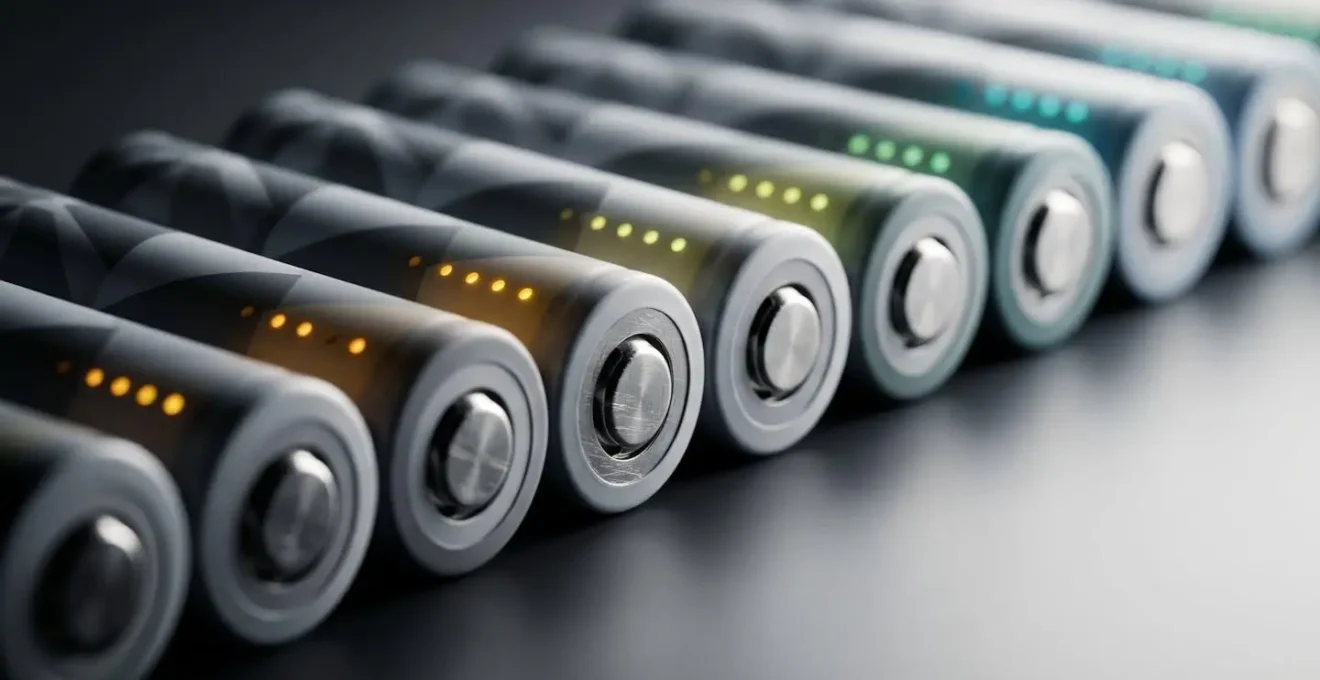
As the visual representation of battery cells suggests, power is a finite resource. Power budgeting forces you to use task-appropriate lighting, which not only extends your battery life but also enhances visual courtesy by minimizing excessive brightness. It’s the practical application of using only as much light as you truly need.
The battery storage mistake that leaves you in the dark
You packed your headlamp weeks ago. The batteries were fresh. But when you arrive at the campsite and night falls, you click the button and get… nothing. The culprit is often a silent power thief: parasitic drain. Even when turned off, the complex electronic circuits in modern headlamps draw a tiny amount of current to remain in a standby state, ready to be activated. While minimal, this steady trickle can completely deplete your batteries over several weeks or months of storage.
This standby current is a normal feature of most electronic devices; some studies indicate that a typical parasitic draw is in the range of 50-85 milliamps for vehicle electronics, and while a headlamp’s is much smaller, the principle is the same. An even bigger risk is accidental activation. A button pressed inside a crowded backpack can turn the headlamp on at a low setting, draining the battery completely before you ever reach your destination. Fortunately, preventing this is simple with proper storage discipline.
Following a clear set of steps can ensure your headlamp is always ready when you are. The goal is to create a physical or electronic break in the circuit, stopping any and all power flow during long-term storage.
Action Plan: Preventing Battery Drain During Storage
- Isolate the Power Source: For long-term storage (over a month), use a mechanical disconnect. Unscrew the tailcap or battery cover by a quarter-turn to physically break the electrical connection. This is more foolproof than electronic lockouts.
- Store at Optimal Charge: If using lithium-ion batteries, don’t store them fully charged or fully depleted. Store them at a 40-70% charge level to maximize their long-term health and lifespan.
- Prevent Accidental Activation: Always store your headlamp in a hard or semi-rigid case. This prevents objects in your pack from pressing the power button and turning it on accidentally.
- Remove Batteries Entirely: For storage periods exceeding three months, or if using alkaline batteries, it’s best practice to remove the batteries completely from the headlamp to prevent both drain and potential damage from battery leakage.
- Perform Periodic Checks: If storing for an extended season, check the battery voltage monthly. For lead-acid or similar chemistries, maintaining it above a certain threshold prevents permanent damage like sulfation.
Rechargeable vs Alkaline: Which is more reliable in cold weather?
The debate between rechargeable and disposable batteries often centers on cost and convenience, but for a camper, the most important factor is reliability, especially in cold weather. As temperatures drop, the electrochemical reactions inside a battery slow down, reducing its ability to deliver power. However, not all battery chemistries are affected equally. In the cold, lithium-based batteries (both rechargeable Li-ion and disposable Lithium) dramatically outperform their alkaline counterparts.
Alkaline batteries can lose 50% or more of their effective capacity at freezing temperatures. In contrast, while lithium-ion batteries are not immune to the cold, their performance degradation is far less severe. Research demonstrates that a lithium battery might only see a 20-30% drop in capacity at 0°C (32°F). This can be the difference between having a functional light for an entire winter evening versus one that dies within minutes of leaving the warmth of your car.
The following table breaks down how different common battery types perform when the temperature plummets. A critical point to note is the danger of charging Li-ion batteries below freezing, which can cause « plating » and permanently damage the cell. Always warm a Li-ion battery to above 0°C before recharging it.
| Battery Type | Capacity at 0°C (32°F) | Capacity at -18°C (0°F) | Charging Below Freezing | Weight Advantage |
|---|---|---|---|---|
| Alkaline | 70-80% | ~50% | Safe but reduced performance | Standard |
| Lithium-ion | 95-98% | ~70% | Dangerous – causes plating | 50% lighter |
| NiMH (Eneloop) | 85-90% | ~65% | Safe with reduced current | Similar to alkaline |
| Lithium Primary | 95%+ | ~80% | Non-rechargeable | 60% lighter |
For winter camping or trips at high altitudes, the choice is clear: a headlamp powered by Lithium-ion or primary Lithium batteries offers a massive reliability and performance advantage. Keeping a spare battery close to your body (e.g., in an inside pocket) can help keep it warm and ready to perform at its peak when you need to swap it in. Understanding this technical difference is crucial for building a truly dependable lighting system.
How to use your headlamp as a hanging lantern in the tent?
A headlamp’s focused beam is perfect for trail navigation but can be harsh and create sharp shadows inside a tent. A common camper’s trick to create a warm, pleasant, and usable ambient light is to turn the headlamp into a makeshift lantern. This is achieved through a simple technique called « bounce lighting. » Instead of pointing the beam directly where you need to see, you point it at a reflective surface to diffuse the light and illuminate the entire space softly.
The ceiling of a tent is the perfect surface for this. Most modern tents have a light-colored interior fabric that acts as an excellent reflector. Simply hang your headlamp from a gear loop at the tent’s apex, or even set it on the floor, and aim the beam straight up. The light will bounce off the ceiling and scatter throughout the tent, creating a glare-free, even glow that is ideal for changing clothes, organizing gear, or playing a game of cards.
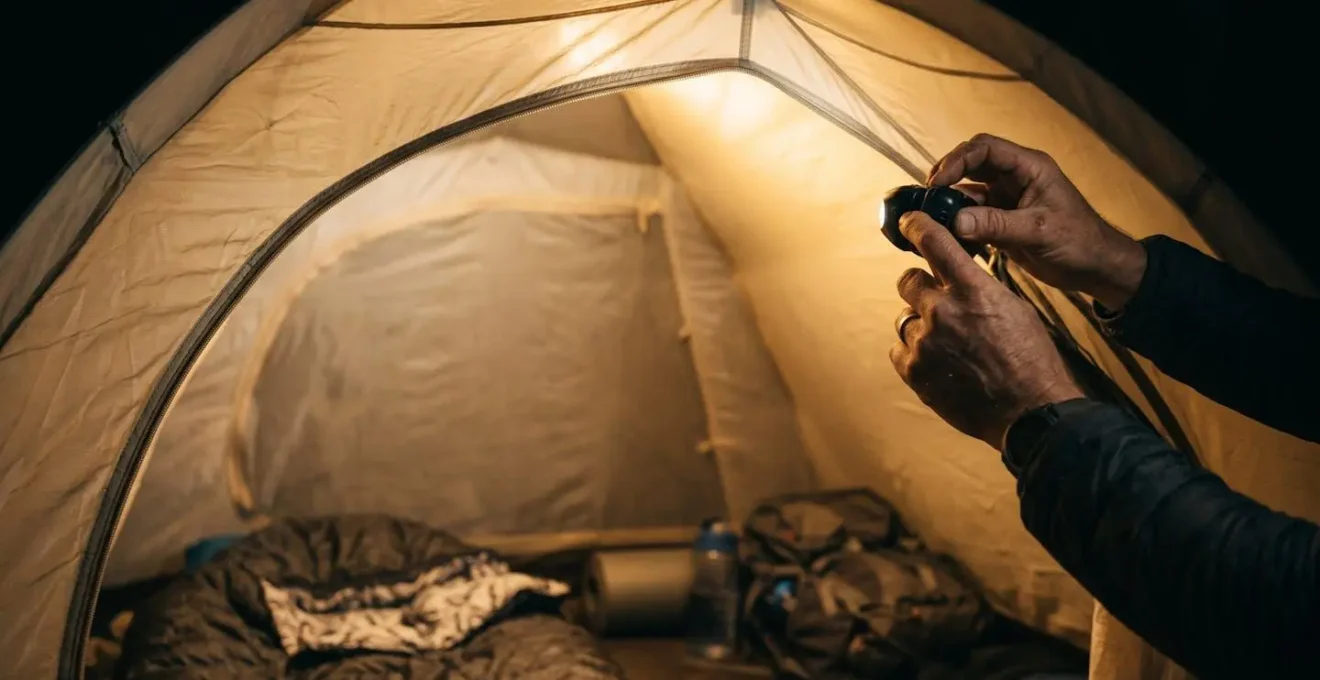
For an even better effect, you can diffuse the light further. Strapping your headlamp to a translucent Nalgene-style water bottle (partially filled with water) creates an instant, highly effective lantern. The water scatters the light in all directions, providing 360-degree illumination. Many headlamp manufacturers and third-party companies also sell small, lightweight silicone diffusers that slip over the head of the lamp to achieve the same effect. This simple hack transforms your functional trail tool into a source of comfort and ambiance, making your tent feel more like a home.
Why 6 Amps isn’t enough for a 2000W hair dryer?
Understanding campsite power limitations often comes down to a simple but crucial electrical formula: Power (Watts) = Voltage (Volts) x Current (Amps). This relationship explains why high-power household appliances are often incompatible with campsite power pedestals, which are typically protected by a 15 or 20 Amp circuit breaker in North America (or 6 to 16 Amps in Europe).
Let’s do the math for a 2000-watt hair dryer on a standard US campsite circuit, which provides 120 Volts. To find out how many amps the hair dryer will draw, we rearrange the formula: Amps = Watts / Volts.
Current (Amps) = 2000W / 120V = 16.67 Amps
This 16.67A draw instantly exceeds the 6A limit mentioned and is also higher than the 15A breaker found on many standard campsite hookups, causing it to trip immediately to protect the wiring. This isn’t a fault; it’s a safety system working as designed. In contrast, an LED headlamp is a marvel of efficiency. Even on a bright 300-lumen setting, a typical headlamp might consume around 3-4 watts of power. The power draw is so minuscule that it’s in a completely different universe from high-draw appliances. This stark contrast highlights the core principle of campsite power management: be aware of the massive difference between efficient, purpose-built camping gear and power-hungry home comforts.
When to use chlorine dioxide tablets instead of UV light?
While this question seems to be about water purification, it’s fundamentally about a core camping principle: prioritizing your power budget. Every device that requires a battery contributes to your total power consumption. When you’re off-grid, especially on a multi-day trip, you must decide which functions are critical enough to warrant using your limited stored energy. This is where the choice between a UV water purification pen and chemical tablets becomes a lesson in power management.
A UV water purifier is an effective tool, but it is entirely dependent on a charged battery. Treating several liters of water for a group can consume a significant amount of power—power that might be drawn from the same power bank you rely on to recharge your essential safety equipment, like your headlamp or GPS device. If you’re faced with a choice between purifying water and ensuring you have light to navigate back to camp after sunset, the priority is clear.
Chlorine dioxide tablets, on the other hand, require zero battery power. They are lightweight, have a long shelf life, and are effective in a wide range of conditions, including turbid (cloudy) water where UV light struggles. By carrying chemical tablets as your primary or backup water treatment method, you are making a strategic decision. You are reserving your precious battery capacity for devices that have no non-powered alternative. Your headlamp, your communication device, your navigation aid—these are the tools for which battery power is non-negotiable. Choosing tablets over a UV pen is an act of acknowledging that electricity is a finite resource in the backcountry and must be allocated to your most critical safety systems first.
Key Takeaways
- Red Light is for Respect: It preserves the rhodopsin in everyone’s eyes, maintaining night vision and demonstrating essential « visual courtesy » at the campsite.
- Budget Your Power: Don’t fixate on maximum lumens. Calculate your lighting needs for the trip and use task-appropriate brightness to ensure your battery lasts.
- Chemistry is King in the Cold: For winter camping, lithium-based batteries (rechargeable or primary) offer vastly superior reliability and performance compared to alkaline.
Campsite Electricity: Why Your Kettle Trips the Breaker Every Morning?
Tripping the campsite breaker is a rite of passage for many new RV or car campers. The cause is almost always an underestimation of cumulative power draw and a lack of awareness of how campsite electrical systems are designed. A standard campsite pedestal is not a home outlet; it has a strict limit, and exceeding it, even for a split second, will shut everything down. Understanding the main culprits is the first step to a smooth, power-filled morning.
The primary issue is the use of high-wattage, heat-generating appliances. A household electric kettle (1500-2000W), a coffee maker (900-1200W), or a space heater (1500W) can each, on their own, push a 15A circuit to its limit. If you try to run two of these simultaneously—or even run one while your RV’s converter is charging the house batteries—you will inevitably cause an overload and trip the breaker. Another hidden factor is « inrush current, » where motors and heating elements draw a brief, high spike of power at startup, which can be enough to trip a sensitive breaker.
To avoid the morning power outage, you must actively manage your electrical load:
- Calculate Total Wattage: Before you plug anything in, add up the wattage of all devices you plan to use. For a typical 15A/120V campsite circuit, your total should stay safely under 1800W (15A x 120V). Aim for 1500W to be safe.
- Power-Up Sequentially: Never turn on multiple high-draw appliances at once. Start your coffee maker first. Once it’s done, turn it off, and then start your toaster. Run only one major appliance at a time.
- Invest in Low-Wattage Alternatives: The market is full of camping-specific appliances. A 700W travel kettle will heat water more slowly than a 1500W model, but it’s far less likely to trip a breaker.
- Manage Background Loads: Be aware of other things drawing power. An electric water heater, an air conditioner, or even a laptop charger adds to the cumulative load. Charge electronics during off-peak times, not while you’re trying to cook breakfast.
This mirrors the same principle of power budgeting we apply to headlamps, but on a much larger scale. It’s about being conscious of your consumption and working within the system’s limits, ensuring a harmonious relationship with the power grid.
By shifting your perspective from chasing specs to mastering the principles of light discipline and power management, you transform a simple headlamp from a purchase into a skill. You’ll not only be better prepared for any situation but will also contribute to a more respectful and enjoyable experience for everyone at the campsite. Start applying these strategies on your next trip to see the difference firsthand.