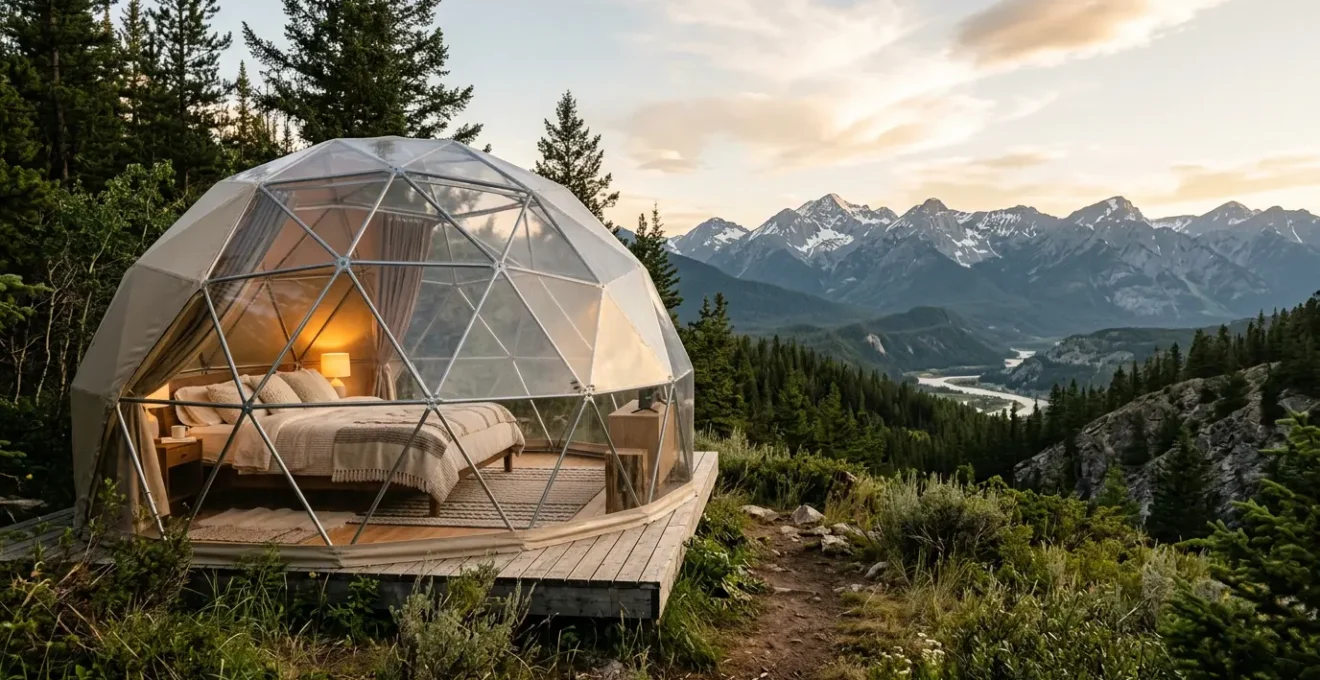
For a $300 budget, the best value isn’t found in thread counts or mini-bars, but in the unforgettable ‘Return on Experience’ (ROE).
- Glamping delivers unique, scarce experiences that standardized hotels cannot replicate, maximizing memorable moments per dollar.
- Hotels offer predictable comfort and convenience, but this safety often comes at the cost of a truly transformative memory.
Recommendation: Choose the hotel for guaranteed physical comfort. Choose glamping for a story worth telling and an experience that appreciates in value over time.
The discerning traveler, faced with a $300-a-night budget, stands at a crossroads. On one path lies the familiar comfort of a traditional hotel—climate control, crisp linens, and the reassuring presence of room service. On the other, the allure of luxury glamping, a promise of nature without sacrificing all creature comforts. The conventional debate pits these two options against each other on a checklist of amenities, a sterile comparison of square footage versus scenic views.
This approach is fundamentally flawed. It misses the critical point that modern luxury is no longer solely defined by tangible assets. The true calculus of value has shifted. When both options command a premium price, the deciding factor should not be what you get, but what the experience gives back to you. The crucial metric is the Return on Experience (ROE)—a measure of the lasting emotional, psychological, and narrative wealth an experience provides long after the credit card bill is paid.
Forget the simplistic pros and cons. The real question is this: where does your $300 investment yield the greatest experiential dividend? This analysis moves beyond the surface to dissect the core value proposition of each. We will explore how factors like engineered comfort, the psychology of novelty, strategic booking, and even the sounds you hear at night all contribute to your ultimate ROE. Through this lens, the choice becomes not just a matter of preference, but a calculated investment in memories.
This guide breaks down the essential factors to consider, moving from the technicalities of comfort to the strategies for securing truly priceless experiences. By understanding the underlying principles of value in modern travel, you can make a decision that pays dividends in stories and satisfaction.
Summary: A Critic’s Guide to Value in Luxury Stays
- Yurt or Geodesic Dome: Which structure offers better insulation in winter?
- Why 65% of first-time campers prefer glamping over tents?
- How to book exclusive glamping sites 6 months in advance without paying premium?
- The heating mistake that makes canvas tents unbearable at night
- How to upgrade a standard glamping package for a romantic proposal?
- Why canvas offers zero decibel reduction compared to wood?
- Why iconic sites sell out in 5 minutes on opening day?
- Yosemite to Dolomites: How to Secure Spots at Iconic Sites 1 Year Ahead?
Yurt or Geodesic Dome: Which structure offers better insulation in winter?
The first objection a hotel loyalist raises against glamping often concerns thermal comfort. The assumption is that a fabric-walled structure cannot possibly compete with the insulated certainty of a hotel. This, however, is a dated perspective. The engineering behind high-end yurts and geodesic domes has transformed them into highly efficient, climate-controlled environments. The question is no longer *if* they can be warm, but *how* they achieve it differently.
A geodesic dome’s strength lies in its structural efficiency. Its spherical shape minimizes exterior surface area, reducing heat loss by up to 30% compared to a rectilinear structure of the same volume. This design, combined with modern multi-foil insulation layers, often results in 25% lower energy consumption for heating. A yurt, on the other hand, relies on the traditional wisdom of thermal mass. Its thick, multi-layered felt or wool walls absorb heat and radiate it slowly, creating a consistent, enveloping warmth that many find more pleasant than the forced air of a conventional heater.
This table, based on an in-depth thermal performance analysis, highlights the nuanced trade-offs:
| Feature | Yurt | Geodesic Dome |
|---|---|---|
| Insulation Material | Felt or wool (traditional); modern synthetic options | Quilted insulation or multi-foil reflective layers |
| Thermal Mass | Heavy felt walls absorb and retain heat | Air volume creates natural circulation for even heating |
| Energy Efficiency | Cylindrical shape less efficient for heat retention | Minimal surface area reduces heat loss by up to 30% |
| Condensation Risk | Lower due to breathable felt | Higher risk of interior condensation if poorly ventilated |
| Acoustic Insulation | Multi-layered walls create superior sound absorption | Hard surfaces create echo-prone interior |
Ultimately, both structures can provide exceptional winter comfort. The dome is an engineering solution, maximizing efficiency. The yurt is an organic one, prioritizing a specific quality of warmth. Choosing between them is less about survival and more about curating the specific sensory experience you desire. The Comfort Predictability of a hotel is matched by the engineered comfort of glamping, neutralizing it as a key decision factor and elevating the importance of the experience itself.

As this cross-section illustrates, the genius of traditional yurt design lies in its layered approach. The dense felt not only insulates but also breathes, managing moisture in a way that sealed plastic membranes cannot. This demonstrates that the core premise of glamping isn’t to poorly imitate a hotel, but to perfect a different, nature-integrated form of shelter.
Why 65% of first-time campers prefer glamping over tents?
The title’s statistic hints at a powerful psychological truth: glamping serves as the perfect « gateway » for those curious about the outdoors but conditioned by hotel standards. It systematically removes the primary barriers to entry—discomfort, complex gear, and lack of amenities—that make traditional camping daunting. For the guest accustomed to a concierge, the idea of setting up a tent in the rain is a non-starter. The idea of arriving at a pre-erected, beautifully furnished safari tent with a real bed is an adventure they can embrace.
This isn’t just theory; it’s a major driver of growth in the outdoor hospitality industry. Glamping isn’t poaching customers from traditional camping; it’s creating a new market by converting hotel-goers. The KOA 2024 Camping and Outdoor Hospitality Report confirms this trend, noting that 34% of new campers now identify as glampers. This demonstrates a significant portion of the market is skipping the tent phase entirely, opting for a higher-comfort entry point.
The high « stickiness » of the experience further validates its value. Once they’ve tried it, these new converts are overwhelmingly likely to return, having found a satisfying middle ground between sterile hotels and rugged camping. As an industry leader confirms, the model is built on successful conversion and retention.
Glamping is a great way to introduce new campers into the camping and outdoor hospitality space, and our research shows once they try glamping, they become very loyal to outdoor hospitality.
– Toby O’Rourke, KOA President and CEO, KOA 2024 Glamping Report
For the $300-a-night traveler, this is crucial. It proves that glamping isn’t a niche, rugged pursuit but a polished, market-tested alternative to the traditional hotel stay. It offers a higher ROE for the uninitiated by providing an accessible taste of adventure without the perceived risks, ensuring a positive and repeatable experience.
How to book exclusive glamping sites 6 months in advance without paying premium?
In the luxury market, the ultimate currency is not money, but access. This is where glamping delivers a stratospheric Return on Experience that most hotels simply cannot match. A $300 hotel room in one city is largely fungible with a $300 room in another. An architecturally unique dome with a private view of a meteor shower, however, is an example of Experience Scarcity. There is only one of it. This scarcity is what drives value.
Securing these high-ROE experiences without paying exorbitant « premium » fees demanded by concierge services requires strategy, not just wealth. It’s about leveraging booking windows and understanding market dynamics. The most sought-after sites operate on fixed booking schedules, often opening their calendars exactly six months in advance to the day. The savvy traveler treats this opening day like a product launch, ready to book the moment the clock strikes.
However, the most potent strategy is to avoid the peak-season rush altogether. By targeting the « shoulder seasons »—the weeks just before or after the high season—one can access the same exclusive property and views, often with better weather, for a fraction of the peak price. This requires a more nuanced approach than simply booking a hotel for a holiday weekend.
Your strategic booking plan for exclusive glamping
- Mark the Window: Identify the precise booking window for your target site (typically 6-12 months). Set a calendar alert for the exact opening day and time.
- Target the Shoulders: Analyze seasonal pricing. Book dates in the 2-3 week period bordering peak season, where weather remains ideal but demand and prices often drop by 20-40%.
- Leverage New Listings: Set up alerts on platforms like Hipcamp or Glamping Hub for newly-listed properties. Owners often offer attractive introductory rates to build a portfolio of positive reviews.
- Book Smarter, Not Harder: If a prime location’s signature dome is booked, consider their less popular accommodation (e.g., a canvas tent on the same property). You often gain access to the same million-dollar views and amenities at a standard rate.
- Automate the Hunt: For sold-out sites, use a cancellation monitoring service. These tools automatically scan for and alert you to newly available dates, snatching a premium spot at its original price.

This strategic approach transforms the act of booking from a simple transaction into a rewarding challenge. The satisfaction derived from securing an exclusive site through clever planning contributes significantly to the overall ROE, an element entirely absent from the impersonal process of booking a standard hotel room.
The heating mistake that makes canvas tents unbearable at night
A common rookie error in glamping is attempting to replicate the brute-force heating of a hotel room. This often involves using an oversized propane heater that blasts hot air, creating a miserable environment. The result is a stratified atmosphere—a scorching hot ceiling and a freezing cold floor—and dangerously low humidity. This is not « rustic charm »; it is a fundamental misunderstanding of the physics of a canvas structure. The real luxury lies in knowing how to create a balanced, comfortable warmth.
The most critical mistake is ignoring the ground. An uninsulated floor will act as a heat sink, draining warmth faster than any heater can produce it. The first principle of canvas tent comfort is to prioritize ground insulation. Using thermal barrier floor liners, thick rugs, and elevated cots or bed frames creates an essential buffer against the cold earth. This single step is more effective than doubling the BTU output of your heater.
The second principle is ventilation. It seems counter-intuitive to open a vent in cold weather, but it is non-negotiable for two reasons: safety and comfort. As noted in a comprehensive guide to heating canvas tents, proper ventilation is crucial to prevent the buildup of carbon monoxide from fuel-burning heaters and to manage condensation. A poorly ventilated tent will trap the moisture from your breath and the heater, leading to damp, clammy conditions that feel colder and can damage equipment. The « rule of two vents » (cracking open a low and a high vent) creates a natural convection that evacuates moisture and dangerous gases without causing a significant draft.
Embracing these principles is part of the experience. It’s a form of Intentional Discomfort that leads to greater comfort—a small, mindful effort that connects you to your environment. Unlike a hotel’s invisible, automated HVAC system, managing your shelter’s climate provides a subtle but powerful sense of accomplishment, boosting the overall Return on Experience.
How to upgrade a standard glamping package for a romantic proposal?
When evaluating Return on Experience, a romantic proposal is a high-stakes scenario where glamping offers an almost unassailable advantage over a traditional hotel. A hotel proposal, no matter how luxurious the suite, operates within a framework of predictability. Champagne, roses, a view of a city skyline—it is a scene played out countless times. Its ROE is diminished by its own cliché.
A glamping proposal, by contrast, is a blank canvas for crafting a unique narrative. Its value lies not in the thread count, but in the co-creation of a story. Upgrading a standard package is less about adding amenities and more about choreographing moments. The process begins by collaborating with the site host, who often acts as a personal concierge and co-conspirator. This personal touch is a form of luxury rarely found in a large hotel chain.

The upgrades are experiential:
- The Arrival: Instead of a generic check-in, arrange for a private path to be lit with lanterns, leading to the secluded tent.
- The Ambiance: Work with the host to have a specific playlist cued up, a personal scent diffused (like cedar or pine), and the wood-burning stove already casting a warm glow upon arrival.
- The Moment: Coordinate a specific natural event as the backdrop—proposing under a full moon, during the golden hour as sun sets over a canyon, or timed with the peak of a meteor shower. This frames the moment with a spectacle no hotel can manufacture.
- The Celebration: Forego the standard champagne and have a curated basket waiting, filled with locally sourced cheese, a favorite craft beer, or ingredients for making s’mores over a private bonfire.
This level of personalization transforms a $300/night stay into a priceless memory. The cost is marginal, but the ROE is exponential. The story is no longer, « He proposed in a hotel, » but, « He proposed in a star-lit dome at the edge of the world, just as a shooting star went by. » That narrative is the ultimate luxury good.
Why canvas offers zero decibel reduction compared to wood?
A hotel room is an isolation chamber. Thick walls, double-glazed windows, and solid-core doors are engineered to create a barrier against the outside world. This quest for silence is considered a hallmark of luxury. Glamping offers a counter-proposal: what if the sounds of the environment are not noise to be blocked, but an essential part of the experience to be embraced? This is not a bug; it is a core feature of the value proposition.
A canvas wall provides near-zero acoustic insulation compared to a wooden or brick wall. You will hear the wind rustling through the trees. You will hear the pitter-patter of rain on the roof, evolving from a gentle tap to a percussive drumming. You will hear the distant call of an owl or the chirping of crickets. For the hotel purist, this is a horrifying lack of control. For the experience-seeker, this is the entire point. You are paying $300 a night for an immersive sensory experience, not for sterile silence.
This auditory connection to the natural world has a profound psychological impact. In an urban world saturated with artificial noise—traffic, sirens, digital alerts—the organic soundscape of nature acts as a restorative balm. It is a well-documented phenomenon that listening to these natural sounds can lower stress, improve mood, and enhance cognitive function. The hotel actively denies you this benefit; the glamping site provides it as an intrinsic part of the package.
The lack of decibel reduction is a powerful contributor to a high Return on Experience. It grounds you in the reality of your location. It creates a vivid, multi-sensory memory that a silent, climate-controlled box cannot. Falling asleep to the sound of rain on canvas is a fundamentally different, and arguably more valuable, experience than falling asleep to the hum of an air conditioner. It’s a key differentiator where a perceived « disadvantage » is, in fact, a priceless advantage.
Why iconic sites sell out in 5 minutes on opening day?
The phenomenon of a glamping site at a location like Yosemite or near the Dolomites selling out its entire six-month inventory in under five minutes is the ultimate testament to Experience Scarcity. It is pure, unfiltered market economics demonstrating an extreme imbalance between supply and demand. This isn’t just about a nice place to stay; it is about securing a non-fungible, high-status experience with a monumental Return on Experience.
Several factors converge to create this digital gold rush:
- Trophy Asset Value: Staying at one of these sites is like owning a rare piece of art. It carries a significant social currency. The ability to post a photo from a specific, famously hard-to-book location provides a status signal that a luxury hotel suite, no matter how expensive, cannot replicate.
- Guaranteed Scenery: These sites are grandfathered into locations where no new construction would ever be permitted. They offer a front-row seat to world-class natural beauty, a « million-dollar view » that is guaranteed and exclusive.
- Finite Supply: Unlike a hotel chain that can build another tower, there is an absolute, fixed number of these prime glamping spots. This hard cap on inventory means that as demand grows, the competition to secure a spot intensifies exponentially.
- The Narrative Lock: The difficulty of booking becomes part of the site’s mystique and its story. The very act of succeeding in the booking process is a victory that enhances the perceived value of the stay before it even begins.
When a $300-a-night spot sells out in minutes, it tells you that the market has valued the experience far higher than its sticker price. People are not just paying for a bed; they are paying for a story, for scarcity, and for a guaranteed peak moment. This is the clearest possible evidence of an astronomical ROE, a value proposition that traditional hotels, with their scalable and replicable inventory, can rarely hope to match.
Key Takeaways
- ROE is the Metric: The ultimate measure of value for a luxury stay is the ‘Return on Experience’—the lasting memories and stories it generates, not just its amenities.
- Glamping’s Edge is Scarcity: Glamping offers unique, non-replicable experiences in nature, creating a sense of ‘Experience Scarcity’ that mass-market hotels cannot match.
- A Hotel’s Strength is its Weakness: The ‘Comfort Predictability’ of a hotel guarantees a standardized, safe experience, but this often precludes the possibility of a truly transformative or memorable moment.
Yosemite to Dolomites: How to Secure Spots at Iconic Sites 1 Year Ahead?
Understanding *why* iconic glamping sites sell out is one thing; mastering the strategy to secure one is another. It requires a mindset shift from casual vacation planning to a quasi-military operation of precision and preparation. This is the final frontier of maximizing your Return on Experience, where the effort of the « hunt » becomes an integral part of the reward. For these top-tier sites with 12-month booking windows, success is determined long before opening day.
First, create a master file for your target location. This involves deep reconnaissance: pinpoint the exact date and time reservations open (down to the second, accounting for time zones), have multiple browser tabs open and logged into the booking portal, and have all personal and payment information pre-filled or auto-saved. It is a game of milliseconds. On opening day, you are not browsing; you are executing a pre-planned transaction.
Second, build flexibility into your plan. Your primary target date may vanish instantly. Have a list of second and third-choice dates, preferably mid-week, ready to go. Broaden your options by also considering the shoulder seasons just outside the peak demand window. An early October booking may offer stunning autumn colors and a fraction of the competition of a late September date.
Finally, engage the human element. For privately owned sites, follow their social media channels. They often drop hints about cancellations or last-minute availability. A polite, concise email expressing your keen interest and flexibility can sometimes place you on an informal waitlist. In a world of automated bots, a personal touch can occasionally work wonders. Securing one of these coveted spots is the culmination of the entire ROE philosophy: it’s an investment of effort and strategy that pays off with an experience that is, by definition, priceless because it is so fiercely sought after.
The next time you budget for a getaway, don’t just ask what you’ll get for your money. Ask what the experience will make of you. The highest Return on Experience awaits the traveler who understands that a memory is the only luxury that appreciates over time.