In summary:
- Securing top campsites is a strategic game, not a lottery. It requires understanding the system, not just being fast.
- Leverage the « second market » of cancellations with automated alert apps, configured for maximum efficiency.
- Abandon the myth of arriving at dawn for first-come, first-served sites; mid-week, mid-morning arrivals are far more effective.
- Plan for modern risks like wildfire smoke, not just traditional weather, and use shoulder seasons for unique, crowd-free experiences.
The 7:00 AM alarm rings. You have your browser open, your fingers poised over the keyboard, ready to click « Book Now » the second the reservation window opens for that perfect campsite in Yosemite Valley or a stunning pitch with a view of the Dolomites. Five minutes later, every single spot is gone. This frustrating ritual is a shared pain point for countless organized travelers, turning dream trips into logistical nightmares. The common advice— »be fast, » « be flexible »—feels hollow when you’re competing against thousands of others, and seemingly, automated bots.
Most guides focus on these surface-level tips, failing to address the deeper mechanics at play. They might mention using a cancellation app or trying for a first-come, first-served (FCFS) spot, but they don’t explain the strategic systems that separate the successful from the disappointed. The truth is, this process has evolved from a simple booking into a form of reservation warfare, where knowledge of the system is your most powerful weapon.
But what if the key wasn’t just being faster, but being smarter? What if you could play the game by understanding its hidden rules? This guide shifts the perspective from one of luck to one of strategy. We will deconstruct the entire process, revealing the tactical approaches seasoned planners use to secure these coveted spots. We’ll move beyond the basics to explore how to master cancellation alerts, leverage seasonal timing, outsmart the FCFS crowds, and navigate complex permit systems like an insider.
This article provides a complete framework for turning your camping aspirations into confirmed reservations. Follow the detailed strategies outlined in each section to build a plan that consistently puts you ahead of the competition.
Summary: A Strategic Planner’s Guide to Booking World-Class Campsites
- Why iconic sites sell out in 5 minutes on opening day?
- How to use cancellation apps to snag a last-minute spot?
- The seasonal mistake that ruins views with fog or crowds
- Shoulder season vs Peak season: Is the weather risk worth the solitude?
- When to arrive at the gate to get the best first-come-first-served pitch?
- How to book exclusive glamping sites 6 months in advance without paying premium?
- How to obtain a backcountry permit for high-demand zones?
- Camping in National Parks: How to Navigate Permit Systems Like a Ranger?
Why iconic sites sell out in 5 minutes on opening day?
The heart of the problem isn’t just high demand; it’s a perfect storm of limited supply, synchronized human traffic, and technology. Iconic national parks like Yosemite and Zion have a finite number of campsites, a number that hasn’t grown in decades. Simultaneously, the number of people seeking outdoor experiences has exploded. When the reservation window opens—for example, at 7 AM PST on the 15th of the month for a slot five months later on Recreation.gov—hundreds of thousands of hopefuls log in at the exact same moment, creating a digital bottleneck.
This massive, coordinated surge is only part of the story. The playing field is further skewed by the rise of sophisticated booking bots. These automated scripts can select a site, fill in user details, and complete the checkout process in a fraction of a second, far faster than any human can type. While reservation platforms are constantly fighting this, many spots are snatched up by bots operated by scalpers or even individuals trying to gain an edge. This technological arms race is a key reason why camping reservations for Yosemite tend to sell out within minutes, creating a system that feels impenetrable.
Understanding this dynamic is the first step toward building a better strategy. You are not just competing against other travelers; you are competing against the clock and against automated systems. Simply being ready to click at the right time is no longer enough. The real opportunity lies in playing a different game entirely, focusing on the phases before and after this initial five-minute frenzy.
How to use cancellation apps to snag a last-minute spot?
Since the initial reservation window is a high-stakes gamble, the most effective counter-strategy is to focus on the « second market »: the constant stream of cancellations. People’s plans change, and a significant percentage of bookings are cancelled. This is where cancellation scanning services like Campnab, Arvie, or Recreation.gov’s own notification feature become indispensable tools in your reservation warfare arsenal. However, simply turning on a notification is a novice move. The key is to configure your alerts with surgical precision.
A professional approach involves setting up multiple, layered scans. Don’t just scan for your perfect week at the most famous campground. Create a portfolio of alerts. For example, one scan could target a specific prime weekend. A second, more flexible scan could search for a 10-day window during the shoulder season. A third could monitor a desirable but less-famous backup campground. By diversifying your scans, you dramatically increase your probability of success. Furthermore, always enable SMS notifications. An email alert might sit in your inbox for an hour, by which time the newly available spot will be long gone. A text message allows for the immediate response necessary to claim the opening.

The goal is to transform from a passive waiter to an active hunter. Your phone becomes a strategic tool, constantly probing the system for opportunities. This approach requires more initial setup but pays dividends by turning the high cancellation rate from a source of frustration into your greatest advantage. It’s about letting technology work for you 24/7, long after the initial booking rush has subsided.
- Select up to 6 campgrounds and use the « Specific sites » filter to narrow your scan.
- Define necessary parameters like RV hookups, tent-only, or accessibility needs.
- Set your arrival date and activate « Flexible Dates » to scan the two days before and after.
- Configure multiple scans: one for a perfect weekend, another for a flexible 10-day window, and a third for a backup campground.
- Enable SMS notifications for the fastest possible response time.
The seasonal mistake that ruins views with fog or crowds
Many travelers meticulously plan their trips around traditional weather patterns, aiming for the driest, sunniest months of July and August. While this seems logical, it’s often a strategic blunder. This peak season guarantees two things: maximum crowds and peak pricing. In recent years, a far more disruptive factor has emerged that many guides overlook: wildfire smoke. Especially in western North America, late summer is now unofficially « smoke season, » where vast plumes can travel hundreds of miles, completely obscuring iconic vistas and creating hazardous air quality for days or weeks on end.
The strategic planner no longer just checks the forecast for rain; they monitor air quality indexes (AQI) and smoke maps. A clear day with an AQI of 150+ is far worse for hiking and photography than a cool, overcast day with clean air. The problem of overcrowding is equally detrimental. For instance, in 2022 alone, nearly 3.7 million visitors flocked to Yosemite, leading to waits of up to four hours just to enter the park during the busiest periods. This isn’t a vacation; it’s a traffic jam.
Choosing a season is therefore a calculated risk assessment. By fixating on the « perfect » summer weather, you may be walking into a trap of crowds and unforeseen environmental hazards. A smarter approach involves weighing these factors and often looking towards the shoulder seasons, where the risks are different but often more manageable, and the rewards can be far greater.
Case Study: Using Modern Tools to Mitigate Wildfire Smoke Risk
The EPA’s AirNow Fire and Smoke Map offers daily AQI forecasts for particle pollution, serving as a vital planning tool. Advanced models like NOAA’s HRRR-Smoke even allow campers to predict smoke patterns days in advance. This addresses a critical travel variable that has become more impactful than clouds or fog in many North American national parks during summer, a factor traditional guidebooks often fail to cover adequately.
Shoulder season vs Peak season: Is the weather risk worth the solitude?
The debate between peak season and shoulder season (late spring or early fall) is a core strategic decision. Peak season offers predictability—warm weather and fully accessible roads—but at the cost of intense crowds and premium prices. Shoulder season presents a trade-off: the weather is more variable and some high-elevation passes may be closed, but the reward is solitude, lower costs, and often, unique natural spectacles that peak-season visitors miss entirely.
For a strategic planner, this isn’t a simple choice; it’s a risk-reward calculation. For example, a trip to the Dolomites in early October might involve a risk of early snowfall but also offers the chance to see the larch trees turn a brilliant gold against a backdrop of dramatic peaks, with a fraction of the summer crowds. Similarly, visiting Yosemite in late May could mean some higher trails are still snowy, but it also means witnessing the park’s waterfalls at their most powerful and enjoying wildflower blooms in the valley.
The key is to align the season with your priorities. If your sole goal is to drive Glacier National Park’s Going-to-the-Sun Road from end to end, the narrow window of July and August might be necessary. But if your goal is a deeper, more peaceful experience, the « weather risk » of the shoulder season is almost always worth the immense reward of solitude. In places like the Dolomites, gateway towns can be 30-50% cheaper, and the relaxed atmosphere allows for spontaneous decisions that are impossible in the rigid, fully-booked peak season.
This comparative analysis shows the clear trade-offs between the two main travel periods. As demonstrated by a recent comparative analysis from National Geographic, the value proposition of shoulder season is increasingly compelling.
| Factor | Peak Season (July-August) | Shoulder Season (Sept-Oct / May-June) |
|---|---|---|
| Weather Reliability | High – Predictable warm/dry conditions | Moderate – Variable but often mild temperatures |
| Crowd Density | Very High – Long lines, full parking, crowded trails | Low – Shorter lines, relaxed pace, spontaneous flexibility |
| Road/Trail Accessibility | Maximum – All roads open (e.g., Tioga Road, Going-to-the-Sun Road) | Limited – High-elevation roads may close early/open late (June-Sept only) |
| Accommodation Costs | Premium pricing – Gateway towns charge 30-50% more | Discounted – Lower demand leads to better deals |
| Unique Experiences | Standard scenic views | Fall larch colors (Dolomites), wildflower blooms (Yosemite), wildlife activity |
When to arrive at the gate to get the best first-come-first-served pitch?
The common wisdom for securing a first-come, first-served (FCFS) campsite is to arrive at the crack of dawn on a Friday. This is a fundamentally flawed strategy. You’ll be joining a long queue of people with the exact same idea, all competing for the few spots that may or may not have opened up. The professional planner employs timing arbitrage, understanding the flow of camper traffic to arrive not earliest, but smartest.
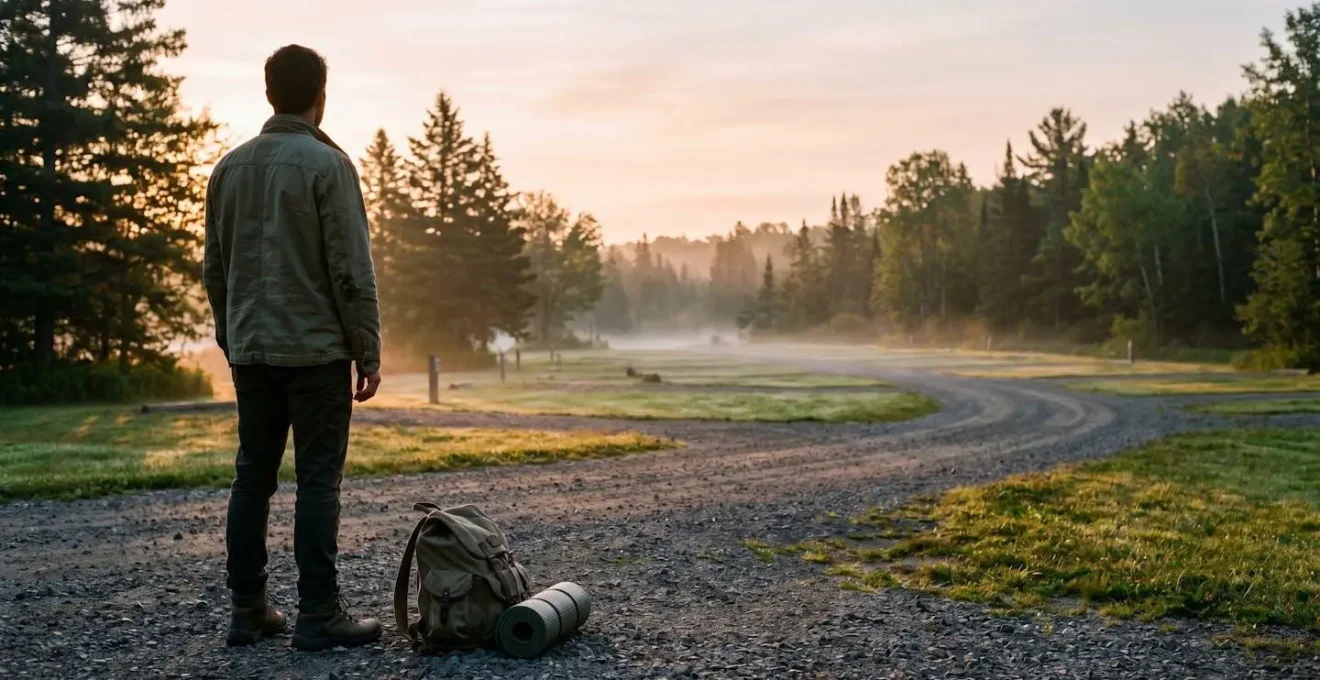
The optimal time to hunt for an FCFS site is mid-morning—around 10 or 11 AM—on a Tuesday or Wednesday. By then, the weekend crowds have long departed, and the next wave has yet to arrive. Checkout times are typically around 11 AM, so this is when sites actually become physically vacant. Instead of waiting in a line at the gate, a better tactic is to perform a « patrol loop » through the campground just before checkout time. Politely observe who is packing up and be ready to claim their site registration tag the moment it’s free. This proactive, on-the-ground approach is far more effective than passive waiting.
Your interaction with rangers should also be strategic. Don’t just ask, « Are there any sites? » This will likely get you a standard « no. » Instead, ask targeted questions that show you’ve done your homework: « Which loop tends to clear out first on a weekday? » or « I have three backup campgrounds in mind; do you know if any of them had openings yesterday? » This positions you as an informed and flexible visitor, making rangers more willing to share insider tips. Have multiple backup plans ready, including lesser-known Forest Service or BLM campgrounds just outside the park’s main boundaries.
How to book exclusive glamping sites 6 months in advance without paying premium?
The allure of glamping—combining outdoor immersion with comfort—has led to the same booking frenzy as traditional campsites, often with an added luxury price tag. Aggregator platforms like Glamping Hub or Booking.com are excellent discovery tools, but booking through them means you’re paying a commission fee that is passed on to you. The key to securing these sites without the premium is to bypass the middleman and employ a direct-booking strategy.
Once you identify a promising glamping operator on an aggregator, your next step is to search for their direct website. Independent operators, particularly in European destinations like the Dolomites, often offer a 10-15% discount for booking directly, as they save on platform fees. This simple step can translate into significant savings, especially for longer stays. This strategy is most effective when booking 4-6 months in advance, before the aggregator-driven demand peaks.
Another tactic is to monitor the market for new entrants. Keep an eye on local tourism board announcements and search Instagram for location tags of your target area. Newly opened glamping sites often offer substantial introductory discounts to build their reputation and attract initial reviews. For maximum value, consider a shoulder-season, mid-week stay. During these quieter periods, operators are often more receptive to negotiation. Proposing a slightly longer stay (e.g., five nights instead of three) in exchange for a reduced nightly rate or an added perk like free breakfast can be a highly effective approach.
Your Action Plan for Booking Exclusive Glamping
- Discover and Research: Use aggregators like Glamping Hub for initial discovery to find operators in your target region.
- Go Direct: Search for the operator’s own website to find direct booking options and bypass platform commission fees.
- Monitor New Openings: Follow local tourism boards and Instagram location tags to find new glamping sites offering introductory discounts.
- Target Off-Peak Stays: Focus on shoulder season and mid-week dates when operators are more flexible with pricing.
- Negotiate Longer Stays: For stays of 4+ nights during off-peak times, contact the operator directly to propose a longer booking in exchange for a reduced rate.
How to obtain a backcountry permit for high-demand zones?
For the most pristine and protected wilderness areas, a campsite reservation is not enough; you need a backcountry permit. These are often distributed via highly competitive lotteries months in advance. When you lose the lottery for a famous route like the John Muir Trail or a zone in Yellowstone, it can feel like the end of the road. However, this is where system gaming and strategic flexibility come into play. There are several advanced strategies to secure a permit outside of the main lottery.
One of the most effective tactics is the « side-door » approach. Instead of applying for a permit starting at the most popular trailhead, plan an itinerary that begins at a less-trafficked, non-quota trailhead, perhaps in an adjacent national forest. You can then hike *into* the high-demand zone on the second or third day of your trip. This requires more complex logistical planning but is a proven method for accessing popular areas. Additionally, analyze the specific rules of each lottery. Some systems may give slightly better odds to smaller groups or have different application quotas for different days of the week.
For walk-up permits (a small number held back for day-of issuance), success hinges on preparation and flexibility. Arrive at the ranger station with multiple backup itineraries ready. If your first choice is unavailable, you can immediately present a viable Plan B and Plan C. Showing this level of preparedness and a willingness to be flexible with your route or group size can significantly increase your chances. As one backpacker’s experience in Yellowstone shows, persistence in scanning for cancellations on Recreation.gov, even after losing the lottery, can pay off. They snagged a prime weekend site in September, demonstrating that the « second market » for permits is just as valuable as the initial draw.
Key Takeaways
- Winning a reservation is a game of strategy, not speed. Focus on understanding the system.
- The « second market » of cancellations is your greatest opportunity. Use automated, multi-layered alerts to exploit it.
- Timing is everything. For FCFS sites, target mid-week, mid-morning arrivals, not dawn on a Friday.
Camping in National Parks: How to Navigate Permit Systems Like a Ranger?
After exploring the specific tactics for reservations, cancellations, and permits, the unifying principle becomes clear: to consistently succeed, you must think like a system manager, not just a visitor. Whether you’re dealing with front-country campgrounds or backcountry zones, you are interacting with complex systems designed to manage scarcity. Understanding the logic, loopholes, and human elements of these systems is the ultimate strategic advantage.
Platforms like Recreation.gov are massive logistical operations. This single platform serves over 21 million users accessing more than 113,000 locations. A ranger’s job is to navigate this system efficiently and fairly. By adopting their mindset, you start to see opportunities where others see roadblocks. You understand that checkout time creates a predictable wave of openings. You know that a failed lottery application is not an end, but the beginning of the cancellation-monitoring phase. You learn that demonstrating flexibility to a ranger is more persuasive than expressing frustration.
This mindset shift is the most crucial takeaway. Stop treating the booking process as a single, high-stakes event. Instead, view it as a continuous campaign with multiple phases and points of entry. It involves pre-planning (researching shoulder seasons and alternative trailheads), a tactical action (the initial booking attempt), a persistent follow-up (cancellation monitoring), and on-the-ground intelligence (FCFS patrolling). By integrating these elements, you move from being a passive victim of the system to an active and informed participant who can navigate it with the confidence and savvy of a seasoned park ranger.
Now that you are equipped with these advanced strategies, the next logical step is to start building your plan. Begin by choosing your dream destination and apply this framework to turn that dream into a confirmed itinerary for your next adventure.